Established as a Belgian colony in 1908, the then-Republic of the Congo gained its independence in 1960, but its early years were marred by political and social instability. Col. Joseph Mobutu seized power and declared himself President in a November 1965 coup. He subsequently changed his name - to Mobutu Sese Seko - as well as that of the country - to Zaire. Mobutu retained his position for 32 years through several sham elections, as well as through brutal force. Ethnic strife and civil war, touched off by a massive inflow of refugees in 1994 from fighting in Rwanda and Burundi, led in May 1997 to the toppling of the Mobutu regime by a rebellion backed by Rwanda and Uganda and fronted by Laurent Kabila. He renamed the country the Democratic Republic of the Congo (DRC), but in August 1998 his regime was itself challenged by a second insurrection again backed by Rwanda and Uganda. Troops from Angola, Chad, Namibia, Sudan, and Zimbabwe intervened to support Kabila’s regime. A cease-fire was signed in July 1999 by the DRC, Congolese armed rebel groups, Angola, Namibia, Rwanda, Uganda, and Zimbabwe but sporadic fighting continued.
Laurent Kabila was assassinated in January 2001 and his son, Joseph Kabila, was named head of state. In October 2002, the new
President was successful in negotiating the withdrawal of Rwandan forces occupying eastern Congo; two months later, the Pretoria Accord was signed by all remaining warring parties to end the fighting and establish a government of national unity. A transitional government was set up in July 2003.
Joseph Kabila as President and four Vice Presidents represented the former government, former rebel groups, the political opposition, and civil society. The transitional government held a successful constitutional referendum in December 2005 and elections for the presidency, National Assembly, and provincial legislatures in 2006.
The National Assembly was installed in September 2006 and Kabila was inaugurated president in December 2006. Provincial assemblies were constituted in early 2007, and elected governors and national senators in January 2007.
In December 2011, Joseph Kabila was reelected for a second term as president. After the results were announced on 9 December, there was violent unrest in Kinshasa and Mbuji-Mayi, where official tallies showed that a strong majority had voted for the opposition candidate Etienne Tshisekedi.
On February 24, 2013 a United Nations-backed accord aimed at stabilizing the Democratic Republic of the Congo called the Peace, Security and Cooperation Framework for the Democratic Republic of the Congo was signed in the Ethiopian capital, Addis Ababa by eleven African countries – Angola, Burundi, Central African Republic, Congo, the Republic of Congo, Rwanda, South Africa, South Sudan, Uganda and Tanzania (UN News Centre 2013).
2 Population
2.1 Population figures: 75,507,308 (August 2013 est.)
Estimates explicitly take into account the effects of excess mortality due to AIDS. This can result in lower life expectancy, higher infant mortality, higher death rates, lower population growth rates, and changes in the distribution of population by age and sex than would otherwise be expected.
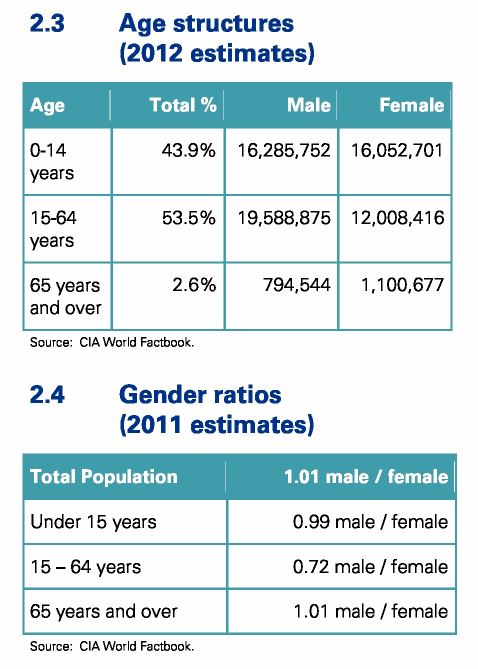
Population growth is slowly recovering. There has been no census in the DRC for over 20 years, and given the flight or internal displacement of much of the population because of years of civil conflict, there are no reliable population data. The IMF estimates the population in mid-2007 at 62.6m and the annual growth rate at 3.3%. This would make the DRC Sub-Saharan Africa's third most populous country, after Nigeria and Ethiopia. About half of the total population is of working age and perhaps 10% are wage-earners. Roughly one-third of the population lives in urban areas.
Life expectancy is slowly improving. After a civil war, which caused the premature death of 4 – 5 million people, life expectancy is slowly rising. The World Bank estimated that life expectancy at birth was 46 years in 2006, up from 41 years in 2001, but still worse than the 52 years estimated in 1990.
The DRC is ethnically diverse. There are, by some counts, up to 400 ethnic groups in the DRC, although the main four are the Mongo, Luba, Kongo and Mangbetu-Azande. Ethnic conflict is endemic in several parts of the country: between the Hema and Lendu around Bunia in Orientale province, between Congolese Tutsis (Banyamulenge) and other groups in the Kivus, and between the Baluba of Kasai and the Lunda of Katanga.
2.2 Population growth rate 2.579% % (2012 est.)
2.6 Ethnic groups
The DRC has over 200 African ethnic groups of which the majority are Bantu. The four largest tribes Mongo, Luba, Kongo (all Bantu), and the Mangbetu-Azande (Hamitic) make up about 45% of the population.
2.7 Religions
Roman Catholic 50%
Protestant 20%
Kimbanguist 10%
Muslim 10%
Other (includes syncretic sects and indigenous beliefs) 10%
3. Economy
The economy of the Democratic Republic of the Congo – a nation endowed with vast potential wealth – is slowly recovering from decades of decline. Systemic corruption since independence in 1960 and conflict that began in May 1997 has dramatically reduced national output and government revenue, increased external debt, and resulted in the deaths of more than 5 million people from violence, famine, and disease.
Foreign businesses curtailed operations due to uncertainty about the outcome of the conflict, lack of infrastructure, and the difficult operating environment. Conditions began to improve in late 2002 with the withdrawal of a large portion of the invading foreign troops. The transitional government reopened relations with international financial institutions and international donors, and President Kabila began implementing reforms.
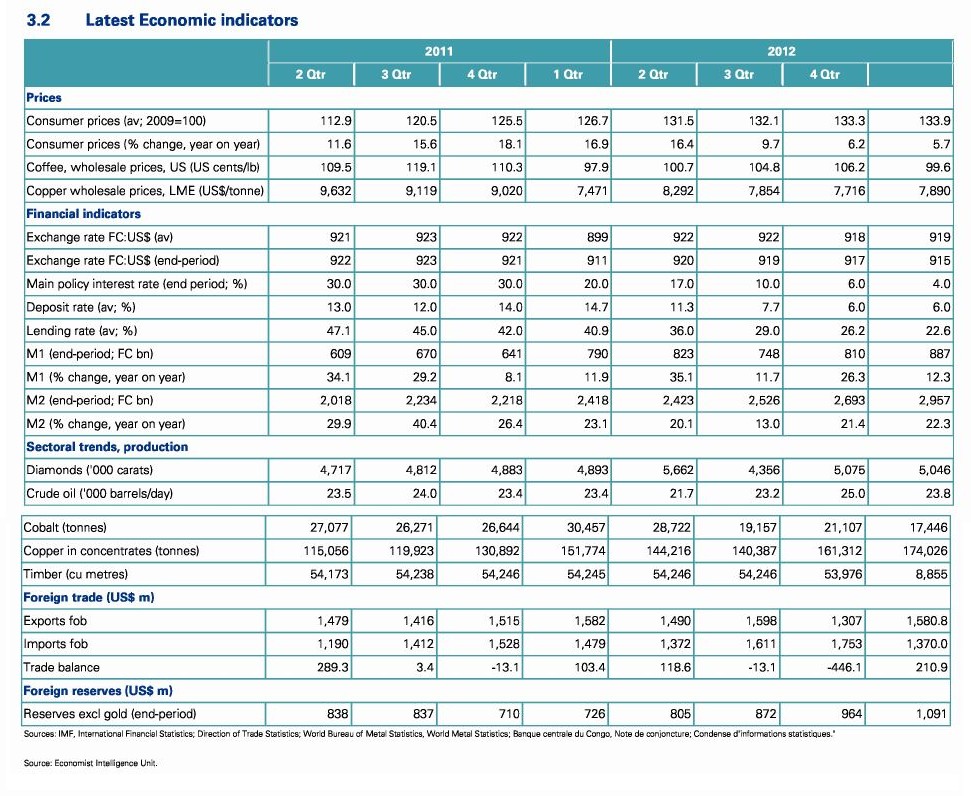
Progress has been slow and the International Monetary Fund curtailed its programme for the DRC at the end of March 2006 because of fiscal overruns. Much economic activity still occurs in the informal sector and is not reflected in GDP data. Renewed activity in the mining sector, the source of most export income, boosted Kinshasa's fiscal position and GDP growth from 2006-08, however, the government's review of mining contracts that began in 2006, combined with a fall in world market prices for the DRC’s key mineral exports temporarily weakened output in 2009, leading to a balance of payments crisis.
The recovery in mineral prices beginning in mid 2009 boosted mineral exports, and emergency funds from the IMF boosted foreign reserves. An uncertain legal framework, corruption, and a lack of transparency in government policy are long-term problems for the mining sector and for the economy as a whole.
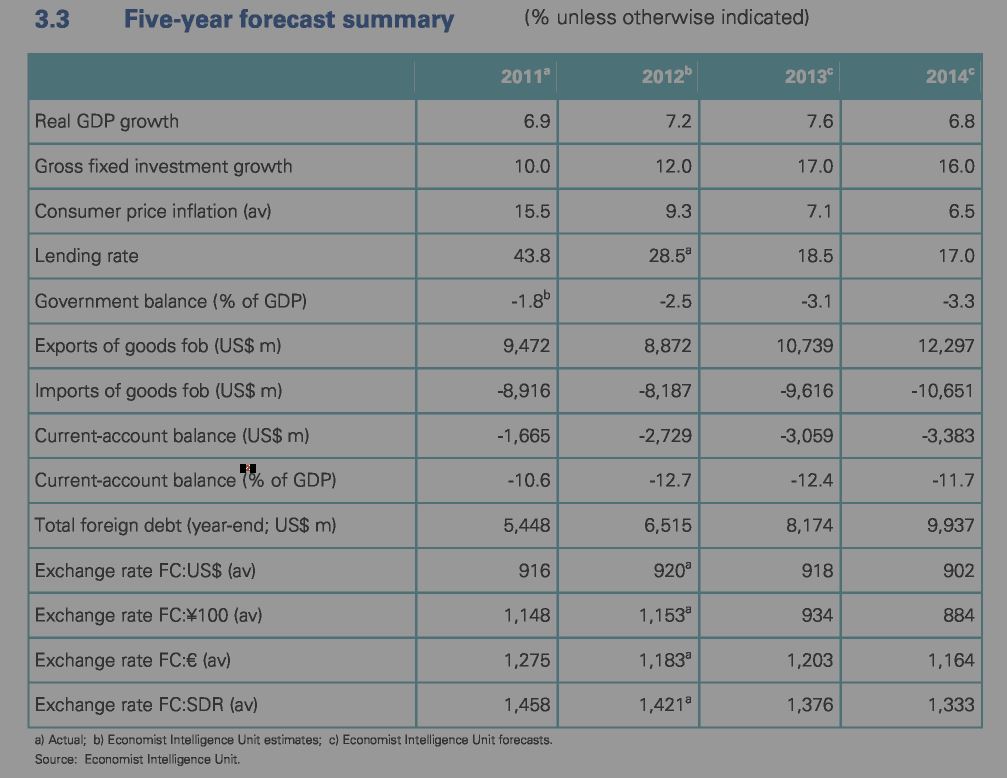
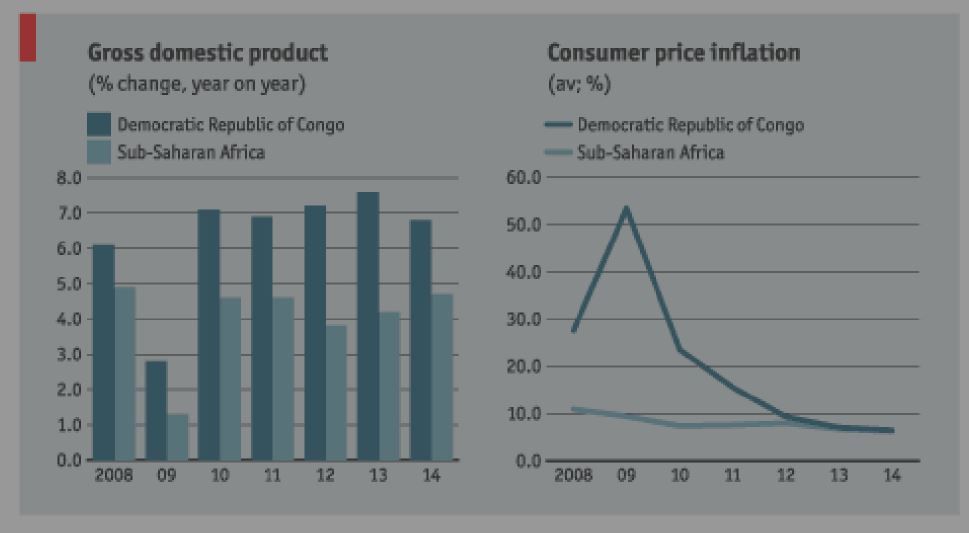
The global recession cut economic growth in 2009 to less than half its 2008 level, but growth returned to 6-7% in 2010-11. The DRC signed a Poverty Reduction and Growth Facility with the IMF in 2009 and received US$12 billion.
3.1 Natural resources
With territory of over 2.34m sq km, the DRC is the largest country in Sub-Saharan Africa, and it is rich in natural resources. Arable land covers only 3% of the country's area, permanent pasture occupies a further 7%, and roughly three-quarters of the country is forested. Commercial logging and deforestation has moved more slowly than in other tropical countries, but its pace is quickening.
Preservation of the DRC's rainforests is believed to be vital to countering global warming and to preserving biodiversity: the country is claimed to be home to 415 species of mammal, 736 species of bird and about 11,000 plant species. As well as forest, natural resources include bountiful fresh water, particularly from the Congo River, oil and numerous minerals.
The main minerals are copper, cobalt, zinc, diamonds and columbo-tantalite (coltan). Cadmium, cassiterite (tin ore), gold, silver, wolframite (tungsten ore) and uranium (at least until 2004) are mined on a smaller scale. Most mining of base metals takes place in Katanga. Most diamond production is in the Kasai provinces. Smaller-scale production occurs in Equateur, and near Kisangani in Orientale province. Coltan and cassiterite have become important exports in Maniema, and North and South Kivu. There are vast gold deposits – said to be the richest undeveloped gold deposits in Africa – in the Kilomoto concessions of Orientale province and around Twangiza in South Kivu.
5. Transport and Communications
Technologically, the DRC is far behind the rest of the continent mainly due to the prevailing impact of years of mismanagement and conflict.
Transport infrastructure has been neglected since independence, Road and rail networks and capacity have both shrunk over the past 48 years, and although there are more internal flights today than at independence, the country has a poor record of air safety.
The government has plans to spend billions of dollars on the road and rail network, if the loans can be secured from Chinese banks. Telecoms have been transformed in the past ten years. Landlines are rare or non-existent, but mobile-phone coverage has grown, and is set to continue to do so. Internet usage, however, remains very low, and this will not change until fibre-optic cable replaces the current dependence on satellite communications.
5.1 Railways
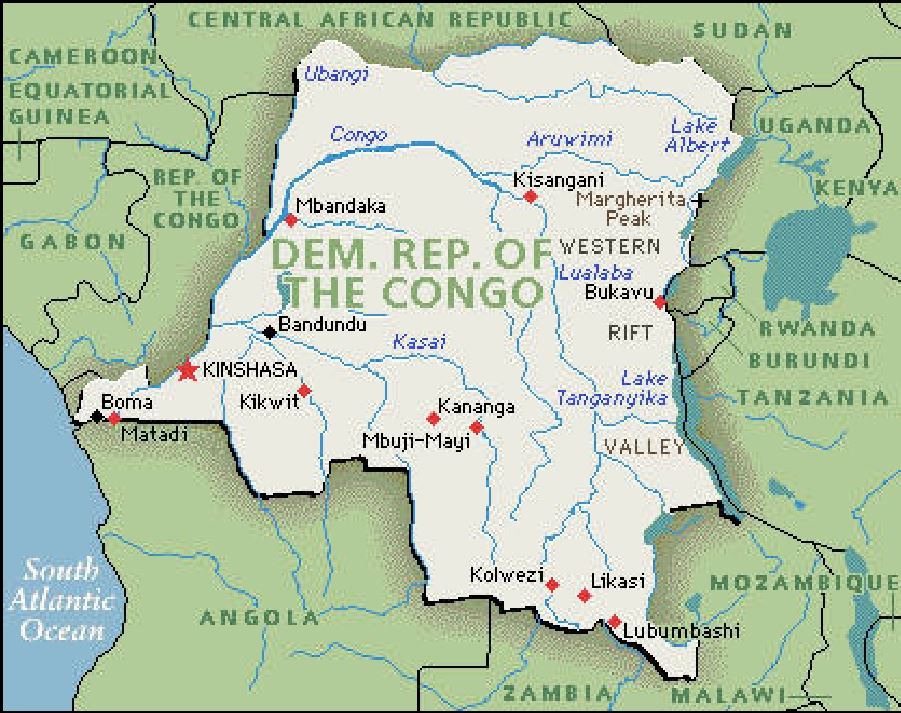
The once extensive railway system has shrunk to minimal service, mostly concentrated in Katanga, for the export of minerals via Zambia to the South African port of Durban. The line between Lubumbashi and Kindu in Maniema province was severed during the civil war of the 1990s. It reopened only in 2007, but track repairs are urgently needed, and only one train runs per month. Another line links Lubumbashi to Ilebo in Kasai Occidental. At Ilebo, cargo was formerly transferred to barges which travel down the Kasai and Congo rivers to Kinshasa, although this link now functions only sporadically.
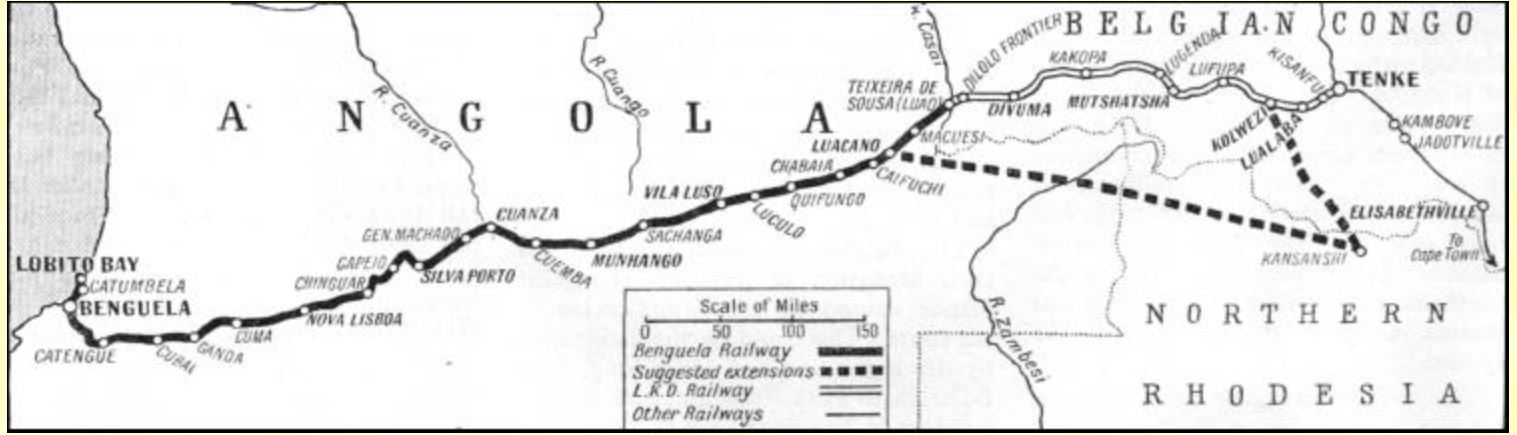
Part of the proposed Chinese loan will be used to restore the railway system, including the line from Kolwezi in Katanga to Dilolo on the border with Angola, where it will link up with the Benguela railway which runs to Lobito on the Angolan coast. The railway, which is the shortest route from Katanga to the coast, functioned during colonial times but ceased operations during the civil war. See history of the Benguela railway.
5.2 Roads
Despite the vastness of the country, only 2,500 km of roads are tarred, and most are in poor condition. Barely any new road has been constructed since independence. Since 2001 the World Bank has supported a programme to rehabilitate existing major roads, and the government hopes that Chinese money will finance further rehabilitation and expansion of the road network, including upgrading the road linking Kisangani in Orientale province with Kasumbalesa in southern Katanga, the main frontier post with Zambia.
5.3 Ports
The Congo River and its tributaries are open to navigation over long distances, although the stretch between Kinshasa and the Atlantic Ocean is blocked by a series of rapids. There are irregular passenger and freight services between Kinshasa and Kisangani, for which new vessels are urgently required. There is also vigorous trade between Kinshasa and Brazzaville, which lies just across the Congo River.
The country's main port is Matadi, around 150 km up the Congo River from the Atlantic. The port's infrastructure is in a state of disrepair, although this is improving slowly.
Administrative delays and bureaucratic obstruction remain obstacles to traffic. Matadi is linked to Kinshasa by rail, but the service is slow and unreliable. The 250-km road between Kinshasa and Matadi is still in poor condition, despite funding from the EU and World Bank for its repair. There is a smaller port, Boma, further downriver.
5.4 Air transport
Because of the poor state of ground transport, the long distances involved and insecurity in much of the country, air transport is much used for both freight and passengers. However, air traffic is ineffectively regulated, aircraft are often not airworthy, and there have been several air crashes in recent years. There are around 50 private air transport companies, most with aircraft and air crews from the former Soviet Union. The national airline, Hewa Bora, was established through the merger of two other state companies and is a joint venture with the privately owned Congo Air Lines (CAL). Hewa Bora operates domestic flights as well as flights to Johannesburg, but has been banned from EU airspace.
Air France flies between Kinshasa and Paris, and SN Air Brussels between Kinshasa and Belgium. There are flights to a number of African destinations throughout Africa, including Nairobi (Kenya Airways); Addis Ababa (Ethiopian Airways); Luanda (TAAG); and Johannesburg (South African Airways).
The UN mission in the DRC operates regular scheduled services to the major cities in the country.
5.5 Telecommunications
In 2008 there were estimated to be just 8,000 functioning fixed lines in the country, but over 6.3m mobile phones in operation. Landline use appears to be in decline, but mobile-phone use is growing steadily, and operators believe that there is a potential market of over 30million subscribers. There are five main operating companies; Vodacom and Celtel are the market leaders. Average revenue per user is US$10-15/month, similar to Nigeria. An important constraint to future growth is the absence of a national fibre-optic network, or a connection to the South Atlantic-3/West Africa Submarine Cable (SAT-3/WASC), which forces operators to rely on satellites only.
The 2002 telecoms law is vague on the division of powers between the national post and telecoms company, the Office congolais des postes et télécommunications, and the new regulatory authority, the Autorité de régulation de la poste et télécommunication du Congo, resulting in a struggle between the two institutions to the detriment of the overall regulation of the sector. Among the pressing issues to be resolved are which companies should build the fibre-optic network and link to SAT-3/WASC, the auctioning of the 3G (third-generation) spectrum, and overcrowding on the 900-mhz frequency. There are several local Internet service providers, but overall national Internet usage, particularly outside the capital, is very low.
5.6 Internet
The development of the internet in the DRC has been hampered by lack of a viable fixed network infrastructure and the low penetration of PCs. Internet access in the main centres of the country is largely achieved through wireless technology notably CDMA and GSM. The most common method of achieving access has been through the various cyber cafés that have emerged in the cities. The current user base in the DRC is estimated to be between 60,000 and 70,000. However, the ISPs in the DRC appear to be seeking ways of best fast tracking the growth of the internet in the DRC with the recent announcement that three ISPs had initiated the Congo Exchange Point. The point will be a default route to be optimised at a later stage.
 Established as a Belgian colony in 1908, the then-Republic of the Congo gained its independence in 1960, but its early years were marred by political and social instability. Col. Joseph Mobutu seized power and declared himself President in a November 1965 coup. He subsequently changed his name - to Mobutu Sese Seko - as well as that of the country - to Zaire. Mobutu retained his position for 32 years through several sham elections, as well as through brutal force. Ethnic strife and civil war, touched off by a massive inflow of refugees in 1994 from fighting in Rwanda and Burundi, led in May 1997 to the toppling of the Mobutu regime by a rebellion backed by Rwanda and Uganda and fronted by Laurent Kabila. He renamed the country the Democratic Republic of the Congo (DRC), but in August 1998 his regime was itself challenged by a second insurrection again backed by Rwanda and Uganda. Troops from Angola, Chad, Namibia, Sudan, and Zimbabwe intervened to support Kabila’s regime. A cease-fire was signed in July 1999 by the DRC, Congolese armed rebel groups, Angola, Namibia, Rwanda, Uganda, and Zimbabwe but sporadic fighting continued.