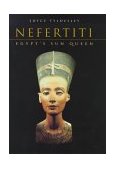
 Nefertiti was the beloved wife of "heretic king" Akhenaton, who defied ancient custom by practicing monotheism and by elevating Nefertiti far above the role of subservient consort previously played by Egyptian queens. Her image has ravished Western viewers ever since a magnificent limestone bust unearthed at the royal retreat of Amarna went on display in Berlin in 1924. But frustratingly few facts are known about this woman who lived more than three millennia ago. As she did in Hatchepsut: The Female Pharaoh, British archeologist Joyce Tyldesley makes a virtue of necessity by writing a book that is as much a cultural history as a biography. As Akhenaton swept away the plethora of old gods, dismaying many of his subjects, he needed a strong female figure to soften the abstract austerity of Aten, the sun deity; his beautiful queen was celebrated in official art and inscriptions that focused on the domestic life of the royal family. Tyldesley meticulously analyzes this iconography to evaluate Nefertiti's position in Egypt and her importance to her husband, who clearly cherished her beyond the demands of propriety or political necessity. The author cannot give readers a strong sense of Nefertiti's personality--the evidence simply isn't there--but she paints a wonderfully evocative picture of life at the civilized heart of the ancient world. --Wendy Smith
From Kirkus Reviews , February 1, 1999
In Hatchepsut (1996), Tyldesley (Archaeology/Liverpool Univ., England) brought to life an obscure female ruler of ancient Egypt's 18th Dynasty. Here she does the same for a legendary woman of the same periodthe queen of monotheist pharaoh Akhenaten. Nefertiti (literally meaning, ``a beautiful woman has come'') became famous with the 1912 discovery by archaeologists of a breathtaking painted bust of her. What little was known of her story suggested dramatic potential: the wife of an intellectual ruler who rejected Egypt's traditional polytheistic cult in favor of an austere monotheistic religion, Nefertiti was a central figure in the capital city, Akhetaten (now Amarna), founded by her husband. But her life, and his, ended with a mysterious oblivion. As if they had merely vanished, records made no mention of the royal couple. Without resolving the cluster of historic mysteries surrounding Nefertiti, Tyldesley evokes the turbulent reign of Akhenaten, whose cult threatened the power of Egypt's priesthood and undermined the kingdom's customary religion. Marshaling archaeological and textual evidence, the author depicts Akhenaten's family as close-knit, with their idyll interrupted by the sudden death of the couple's daughters, attributed by Tyldesley to the plague. Reviewing some of the scholarly theories for Nefertiti's disappearancethat she grew too powerful, ruled Egypt in her own right, or committed a heinous crime and was banishedTyldesley concludes that insufficient evidence exists to support these theories. More likely, as his consort, Nefertiti simply shared in Akhenaten's fate when successor Horemheb, a traditionalist, tried to eradicate all memory of the monotheist pharaoh and his descendants. A thoughtful and well-researched re-creation of an extraordinary ancient personality. (16 pages b&w photos, 38 figures, 2 maps) -- Copyright ©1999, Kirkus Associates, LP. All rights reserved.
Book Description
In the tradition of her intriguing Hatchepsut, Joyce Tyldesley rescues another female ruler from the shadows of history c. 1350 b.c.: Queen Nefertiti (literally "a beautiful woman has come"). We know her from the exquisite painted bust in the Berlin Museum, discovered in 1912, which has made her ancient Egypt's most recognizable queen and a symbol of her country's history. Until now, however, she has remained largely unknown and unrecognized for her contributions to Egyptian society. Wife of Akhenaten, the monotheistic pharaoh, adored by her family, blessed by the sun god, and worshiped by her people, Nefertiti suddenly and completely vanished from the record. Was she banished by her husband or raised to rule as his equal? Did she reign, under another name, in her own right? Could she have been the eminence grise behind the young Tutankhamen, her son-in-law? Tyldesley synergizes archeological, textual, and artistic evidence in a detailed discussion of Nefertiti's life and times at the ephemeral and heretical Amarna court. Nefertiti is a radical re-creation of the woman who was the most influential in the Bronze Age world.
Created on ... août 03, 2003