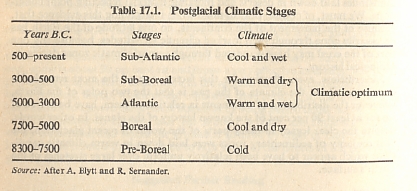
 (Table 17.1). The names suegested by them, notably Boreal and Atlantic, are in common use as the main divisions of the post-glacial period, although their precise reality in climatic terms is still a mat ter for discussion.
One often hears that `the climate isn't what it used to be'. Nostalgic recall of long Edwardian summers or the perpetual clear skies of the Battle of Britain during the Second World War inevitably raises the question: is our climate constant or does it change with time? This topic is not only a subject for considerable speculation, but has also given rise to a large body of scientific research, especially in recent years as our better understanding of the workings of the general circulation has made it possible to identify some of the more immediate causes of climatic change.
Two main aspects of climatic change will concern us in this chapter, that of climatic record and the possible causes of change. The evidence for reconstructing the record is very diverse, covering archaeology, history, botany, zoology, geology and glaciology, as well as meteorology and oceanography.
The primary evidence for climatic change many millions of years ago is the rocks themselves. Their sediments and fossils tell us a great deal about the environment in which they were laid down. We may find in close proximity to one another, coal deposits indicating the humid conditions of the tropics, red sandstones laid down in deserts and morainic material reflecting polar conditions. We must, of course, bear in mind when interpreting this evidence that, because of the movement of the continents, no one latitude of the Earth has necessarily gone through such marked climatic vicissitudes, because any one part of the crust may have wandered through several climatic zones during its geological history.
Nevertheless, even allowing for this factor, one of the most remarkable discoveries about the climate of the past is that the two poles of the Earth, whatever the distribution of continents in relation to them, have been free of ice for at least 90 per cent of the known history of the planet. In other words, despite the clear legacy in many parts of the world of recent glaciation, the vast majority of sedimentary rocks were laid down in warm climatic conditions which appear to have been relatively uniform over large stretches of the Earth's surface.
At intervals of many tens of millions of years, geological history has been punctuated by five or six glacial episodes, the oldest known being about 2500 million years ago. The last three occurred at the beginning of the Cambrian (550 million years ago); during the late Carboniferous and Permian periods (250 m.y.); and in the Pleistocene (the last 2 m.y.). Some of the spatial effects of Pleistocene glaciation are described in Chapter Six. Any theory which tries to explain the cause of ice ages would need to take into account not only the tremendous gaps of time between each ice age (macro-scale variations of climate), but also the glacial/interglacial oscillations within them (meso-scale variations). We have seen that during the Pleistocene, at least seven or eight warm/cold cycles have been recorded (see Table 19.1).
At the time of each ice advance, the climate of the whole world appears to have been affected, although there is considerable debate about whether the changes were entirely synchronous throughout the globe. The major climatic belts changed their extent or position, resulting in temperatures about 5°C lower than now in the tropics, and up to 15°C lower in the glaciated middle latitudes. The spectacular nature of these changes inevitably raises the questions, what causes an ice age, and arc we to expect another one? We can try to answer this question in a general discussion of causes later in the chapter.
With the final retreat of the glaciers around 10.000 years ago (8000 n.c.) the climate rapidly ameliorated in middle and higher latitudes. A thermal maximum some 2-3°C warmer than now was reached between 5000 and 3000 n.c. This period is contemporaneous with a wet sub-pluvial episode in Australia and North Africa; settlements flourished in the Sahara. At about 500 B.C. the climate of Europe deteriorated, and a cool wet period set in.
Much of the evidence for this broad pattern of change comes from the study of the remains of plants and their pollen. The Scandinavian botanists A. Blytt and R. Sernander have put fonvard a more detailed scheme based on their work on ancient tree layers and peat deposits (Table 17.1). The names suegested by them, notably Boreal and Atlantic, are in common use as the main divisions of the post-glacial period, although their precise reality in climatic terms is still a mat ter for discussion.
Although it needs care in its interpretation, a great deal of infomiation, mainly literary, is available for the climate of the last 2000 years or so. But this written material is not in the form of accurate meteorological observations. Instead, we have to rely on such works as contemporary descriptions of the weather, which inevitably tend to emphasise storms and floods; agricultural records, particularly the dates of harvesting and crop yields; the records of port closures and openings each winter in northern Europe; and sagas ofvoyages and colonisations. Even the paintings of Constable have been looked at for clues to contemporary weather. From all this, we glean a fascinating tale of climatic variability which in a time of largely rural societies had an important bearing on everyday livelihood.
After the severe deterioration of climate at about 500 B.C., several centuries of poor conditions in northern Europe were followed by drier conditions in the Roman era. This change also seems to have affected much of southern Europe, Asia and North Africa. On the southern shores of the Mediterranean, Roman settlements such as at Carthage increasingly suffered from problems of water-supply, as witnessed by the building of aqueducts. The increasing drought in Asia has been suggested as being an underlying cause of Barbarian invasions of Europe.
The period A.D. 400-1200 was on the whole dry and warm and apparently remarkably storm-free in the Atlantic and North Sea. This was the time of the great Viking voyages to Iceland and Greenland, and possibly America. Grapes were widely grown in England, implying summer temperatures perhaps 1 to 2°C higher than now. But after 1200, another period of weather variation and general decline set in. A number of devastating floods and storms are recorded in northern Europe around 1300. In Greenland and Iceland, the deterioration was particularly marked, and the Viking colonies virtually froze to death. Despite a partial recovery 1400-1500, when southern fruits were introduced into English gardens, conditions remained relatively cool in the sixteenth and seventeenth centuries. From 1540, and still more frequently after 1600, ice blocked the coasts of Iceland for an average of 5-6 months each year.
The period 1550 to 1800 has been called `the Little Ice Age', because in it the glaciers of the mountains of Europe reached their most advanced positions since the beginning of the postglacial epoch. This advance has left well-marked terminal moraines, known collectively as the neoglaeial maximum limit. H. H. Lamb has suggested that polar sea ice at this time stretched south almost to the Faroes and the Shetland Islands (Fig. 17.1). In Britain, interesting evidence is provided by the record of the freezing over of the Thames for each century (Table 17.2). Records cease to be comparable in the nineteenth century because the new London Bridge built in 1831 allowed free tidal movement of water in and out of the river.
The Little Ice Age was a period of agrarian distress in northern countries, farmland having to be abandoned to the ice in Norway, Iceland and the Alps. For the 1780s, we have sufficient evidence to conclude that average temperatures for January were some 2.5°C lower than in the first part of the twentieth century. Although many parts of the northern hemisphere experienced this notable climatic trend, the southern hemisphere does not appear to have suffered so much. It was not until after 1800 that climatic recession set in, lasting to 1900 or later, and leading to great advances of glaciers in the Andes and South Atlantic islands.
Reliable instrumental records of climate have been available for about 125 years. The beginnings of these observations in the middle of the nineteenth century witnessed signs of an amelioration of climate after the Little Ice Age. In fact, the warming trend may have begun as early as the 1820s. This improvement continued throughout the rest of the centuryapart from the decade 1880-90and into the present century until the 1930s This period of a hundred years or so saw a rapid retreat of most of the world's glaciers, with a corresponding attitudinal rise in snowline and treeline. Tundra margins and permafrost limits also retreated northwards, and Arctic ports remained ice-free. In other parts of the world, the amelioration was marked by a significant decrease in rainfall, particularly in tropical areas and in south-cast Australia.
Unfortunately, as far as mid- and high-latitude countries arc concerned, the latest evidence suggests that the warm period of the 1920s and 1930s has come to an end. Since 1940, a slight cooling has taken place, especially in the subarctic zone, where the drop in winter temperatures has been of the order of 2 to 3°C. Elsewhere, although glaciers have not started readvancing, the rate of retreat has dropped markedly. A detailed analysis by Lamb of airflow types affecting the British Isles indicates that there has been a decline in the frequency of days with westerly airflow from 38 per cent in 1898-1935, to 30 per cent in 1938-61 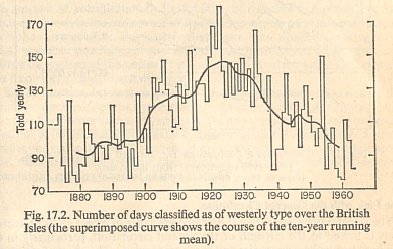 (Fig. 17.2). This decline is linked with an increase in northerly airflow, giving more frequent snowfalls. The trend has also been accompanied by a southward shift of depression tracks which has produced a number of cool wet summers in Britain, notably 1954, 1956, 1958 and 1960. Whether this is part of a new major downward trend in climate or merely a small wobble in the amelioration of the last 125 years is something we must discuss in the next section.
Regional and Global Variations
To gain some insight into the causes of climatic variation, it is worth noting at the outset that some changes appear to occur on a global scale, but many others, particularly those of a short-term nature, arc regionalthat is, they arc climatic changes characterised by an excess of heat or precipitation in one region, but often matched by a corresponding deficiency in another, without mean global values being affected. As long as the amount of radiation from the sun, the solar constant, really does remain constant, then the mean global values of temperature, evaporation and total precipitation should remain unchanged, unless the composition of the atmosphere (e.g. ozone, carbon dioxide content) is altered in some way.
However, one of the most significant discoveries of the last decade is that these global values are not constant. Many of the European trends we have noted earlier have also affected the rest of the world. For example, the notable warm trend up to 1940 has been world-wide, expressed by a general rise in the mean temperature of the world's oceans of 0.7°C in 60 years. This may seem minor, but is substantial considering the volume of water involved, and has had the side-effect of slightly raising sea-level. 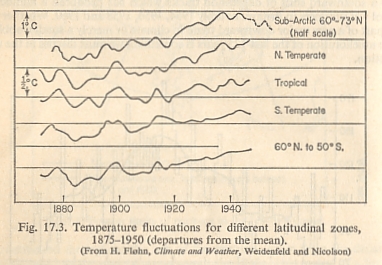 Fig. 17.3 shows temperature fluctuations for several latitudinal zones of the world; the general parallelism of the trends is clear.
Regional changes are basically the result of persistent anomalies and these are superimposed on the less spectacular but perhaps more important global changes. They both have a common connection in the behaviour of the general circulation.
There seems little doubt that the immediate cause of recent climatic fluctuations is linked to the strength of the general circulation, particularly in the northern hemisphere westerlies and in the trade winds. The effect of an intensified atmospheric circulation is to increase the extent of oceanic influence, especially in winter, thereby raising mean temperatures. H. H. Lamb has made a particular study of this thesis. He has shown that the beginnings of climatic amelioration in Europe in the 1820s were linked to a pronounced increase in the vigour of the westerlies over the North Atlantic. This was accompanied by a northward shift in depression tracks, which reached their most northerly mean positions in the 1920s and 1930s. At the sanie time, the mean pressure of the Icelandic low deepened, whereas that of the Azores high and the winter Siberian high increased, resulting in increased pressure gradients over the North Atlantic and Europe.
In other parts of the world, similar relationships between climate and circulation intensity have been noted. It has been suggested that the increased precipitation in Antarctica may relate to the higher incidence of storms in this century.
In the last 35 years, the atmospheric circulation has been weakening. This first became evident a little before 1940, but it was not until the 1950s and 1960s that a resultant increase in the extent of polar ice in the Icelandic and European sectors became apparent.
If we take the argument one stage further and look for the key to these circulation changes, we inevitably return to the fundamental factors of the Earth's energy budget. The link between the distribution of energy and the circulation has been stressed several times in this book. Climatologists have searched repeatedly for periodic trends in the record of climatic fluctuations, and have particularly explored the possibility of a link with the well-known solar cycles. It has to be said that even with the aid of statistical techniques and modern computers, this has met with only limited success. In fact, apart from the daily and annual variations hardly any statistically significant periodicity can he said to exist.
Many attempts have been made to link the well-known sunspot cycle of 11.2 years with meteorological events, but results have been conflicting. Typical is the amount of precipitation in East Africa, as reflected in the levels of Lake Victoria, which in the early years of this century appeared to agree very closely with the sunspot cycle. But latterly there have been marked departures 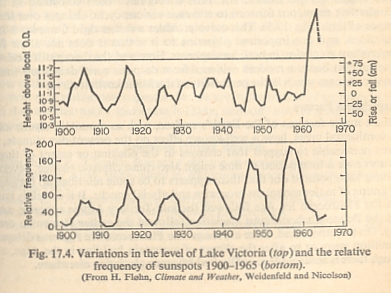 (Fig. 17.4). Another possibility is that a significant double cycle of 22 years exists within the pattern of the general circulation, and involves, among other things, the frequency of blocking anticyclones over Europe.
If a connection between short-term climatic change and solar output does exist, the mechanics of the connection may be complicated and therefore prone to upset from other factors. Changes in the upper atmosphere may be crucial: a recent hypothesis suggests that ozone becomes more abundant at a certain time in the sunspot cycle. The effect of the increase is to warm the stratosphere and weaken the sub-tropical high-pressure belt and in turn the westerlies circulation, causing a period of lower rainfall.
Another possible cause of interference in the Earth's atmospheric budget are changes in the composition of the atmosphere. A link between ozone amounts and the sunspot cycle has just been commented upon. Independent of any solar activity, the amount of carbon dioxide seems to bear a relationship with temperatures. Since the beginning of the century, measurements of carbon dioxide have shown an increase of 10 per cent; this would inevitably lead to an increase in heat absorption, and has been cited as a cause of the warm trend since 1900. On the other hand, it has also been suggested that the presence of large amounts of volcanic dust would reflect the sun's radiation and cause a drop in temperatures. The well-known explosion of Krakatoa in 1883 spread a veil of microscopic dust which eventually covered much of the globe.
Attempts have been made to relate climatic change to variations in the Earth's attitude as a planet. This connection has been invoked in a number of theories explaining the glacial/interglacial fluctuations within the Pleistocene Ice Age. The Earth revolves around the sun in an elliptical orbit, and at the same time rotates itself every 24 hours on an axis inclined at 231° to the plane of the orbit. At the present time, summer occurs in the northern hemisphere when the Earth is farthest away from the sun (aphelion), and the southern summer when it is nearest (perihelion). It is known that over long periods of time the shape of the elliptical orbit changes because of different arrangements of planets in the solar system; that the angle of tilt can vary from 211 to 241°; and that the seasons will gradually swop over. The latter effect is known as the precession of the equinoxes.
It has been argued that any one or all three of these effects could cause considerable variations in the amount of radiation received from the sun, and hence trigger off glaciations. All three effects have been combined in the Milankovitch curve, put forward to embrace various cyclic changes over long periods of time 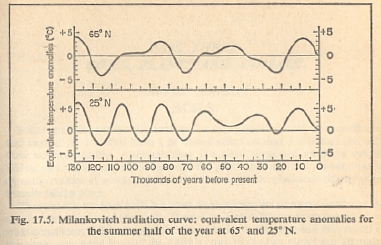 (Fig. 17.5). This curve provides a rather rigid framework for glaciations, and one important objection to it is that it does not allow for synchronous glaciation in both hemispheres. However, the theory still receives some support because modern evidence from deep sea cores does show sonic climatic changes which fit the periodicity of the Milankovitch curve.
Since major features of the Earth's surface, such as mountain chains and the continental areas, have a well-known effect on the present-day climate, it seems reasonable to suggest that changes in the position or extent of these features over a long period of time might also cause climatic change. Several theories have pointed out that there appears to be sonic relationship between the timing of major mountain orogcnies and glacial epochs. It is certainly true that the Pleistocene Ice Age followed the mid-Tertiary Alpine orogeny, and that the Permo-Carboniferous glaciation followed the earlier Hercynian orogeny. On the other hand, there are snags: the Pleistocene Ice Age was delayed 25 million years or so after the climax of mountain building in the Alps, although there is sonic evidence of limited Miocene glaciation elsewhere.
Another suggestion is that glaciation is linked to continental drifting. The Ewing-Donn theory proposes that Pleistocene glaciation was initiated when, relatively speaking, the North Pole reached its present position in the middle of the Arctic ocean, and Antarctica became coincident with the south polar region.
Some tentative progress has been made in recent years in linking short-term regional climatic change with changes in the general circulation of the globe. However, there is no general agreement as to the causes of long-term climatic change. It may be that a combination of causes is the answer. R. F. Flint has suggested a solar-topographic model, which puts forward the idea that radiation and relief factors combined arc necessary to cause an ice age. But to test this model and all the other hypotheses, we require accurate dating of Pleistocene events, and this reality is not with us yet. However, if we take what we know of the climatic record as the best guide to what may happen in the future, the most reasonable view suggests that we arc in the middle of an interglacial, and that another major glaciation is likely, although not for sonic thousands of years yet.
Beekinsale, R. P., 'Climatic change; a critique of modern theories', in Essays in Geography for Austin Miller, edited by Whittow and Wood, University of Reading, Reading, 1965.
Brooks, C. E. P., Climate through the Ages (2nd cdn.), Dover Books, New York, 1970,
Lamb, H. H., The Changing Climate, Methuen, London, 1966.
Lamb, H. H., 'Climatic variation and our environment today and in the coming years', Weather, 1970, 25,447-455.
Mis à jour le 11/10/2016  pratclif.com