Climate Change: Incorrect information on
pre-industrial CO2
Statement written for the Hearing
before the US Senate Committee on Commerce, Science, and
Transportation
March
19, 2004
Statement of Prof. Zbigniew
Jaworowski
Chairman, Scientific Council of Central
Laboratory for Radiological Protection
Warsaw, Poland
I am a Professor at the Central
Laboratory for Radiological Protection (CLOR) in Warsaw, Poland, a governmental
institution, involved in environmental studies. CLOR has a Special Liaison
relationship with the US National Council on Radiological Protection and
Measurements (NCRP). In the past, for about ten years, CLOR closely cooperated
with the US Environmental Protection Agency, in research on the influence
of industry and nuclear explosions on pollution of the global environment and
population. I published about 280 scientific papers, among them about 20 on
climatic problems. I am the representative of Poland in the United Nations
Scientific Committee on the Effects of Atomic Radiation (UNSCEAR), and in 1980
1982 I was the chairman of this Committee.
For the past 40 years I was
involved in glacier studies, using snow and ice as a matrix for reconstruction
of history of man-made pollution of the global atmosphere. A part of these
studies was related to the climatic issues. Ice core records of CO2 have been
widely used as a proof that, due to mans activity the current atmospheric level
of CO2 is about 25% higher than in the pre-industrial period. These records
became the basic input parameters in the models of the global carbon cycle and a
cornerstone of the man-made climatic warming hypothesis. These records do not
represent the atmospheric reality, as I will try to demonstrate in my
statement.
Relevant Background
In order to study the
history of industrial pollution of the global atmosphere, between 1972 and 1980,
I organized 11 glacier expeditions, which measured natural and man-made
pollutants in contemporary and ancient precipitation, preserved in 17 glaciers
in Arctic, Antarctic, Alaska, Norway, the Alps, the Himalayas, the Ruwenzori
Mountains in Uganda, the Peruvian Andes and in Tatra Mountains in Poland. I also
measured long-term changes of dust in the troposphere and stratosphere, and the
lead content in humans living in Europe and elsewhere during the past 5000
years. In 1968 I published the first paper on lead content in glacier ice[1].
Later I demonstrated that in pre-industrial period the total flux of lead into
the global atmosphere was higher than in the 20th century, that the atmospheric
content of lead is dominated by natural sources, and that the lead level in
humans in Medieval Ages was 10 to 100 times higher than in the 20th century. In
the 1990s I was working in the Norwegian Polar Research Institute in Oslo, and
in the Japanese National Institute of Polar Research in Tokyo. In this period I
studied the effects of climatic change on polar regions, and the reliability of
glacier studies for estimation of CO2 concentration in the ancient atmosphere.
FALSE LOW PRE-INDUSTRIAL CO2 IN THE
ATMOSPHERE
Determinations of CO2 in polar ice cores are commonly used
for estimations of the pre-industrial CO2 atmospheric levels. Perusal of these
determinations convinced me that glaciological studies are not able to provide a
reliable reconstruction of CO2 concentrations in the ancient atmosphere. This is
because the ice cores do not fulfill the essential closed system criteria. One
of them is a lack of liquid water in ice, which could dramatically change the
chemical composition the air bubbles trapped between the ice crystals. This
criterion, is not met, as even the coldest Antarctic ice (down to 73oC)
contains liquid water[2]. More than 20 physico-chemical processes, mostly
related to the presence of liquid water, contribute to the alteration of the
original chemical composition of the air inclusions in polar ice[3].
One
of these processes is formation of gas hydrates or clathrates. In the highly
compressed deep ice all air bubbles disappear, as under the influence of
pressure the gases change into the solid clathrates, which are tiny crystals
formed by interaction of gas with water molecules. Drilling decompresses cores
excavated from deep ice, and contaminates them with the drilling fluid filling
the borehole. Decompression leads to dense horizontal cracking of cores, by a
well known sheeting process. After decompression of the ice cores, the
solid clathrates decompose into a gas form, exploding in the process as if they
were microscopic grenades. In the bubble-free ice the explosions form a new gas
cavities and new cracks[4]. Through these cracks, and cracks formed by sheeting,
a part of gas escapes first into the drilling liquid which fills the borehole,
and then at the surface to the atmospheric air. Particular gases, CO2, O2 and N2
trapped in the deep cold ice start to form clathrates, and leave the air
bubbles, at different pressures and depth. At the ice temperature of 15oC
dissociation pressure for N2 is about 100 bars, for O2 75 bars, and for CO2 5
bars. Formation of CO2 clathrates starts in the ice sheets at about 200 meter
depth, and that of O2 and N2 at 600 to 1000 meters. This leads to depletion of
CO2 in the gas trapped in the ice sheets. This is why the records of CO2
concentration in the gas inclusions from deep polar ice show the values lower
than in the contemporary atmosphere, even for the epochs when the global surface
temperature was higher than now.
Figures 1A and 1B
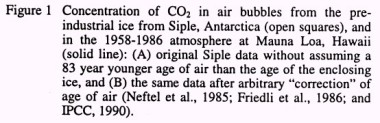
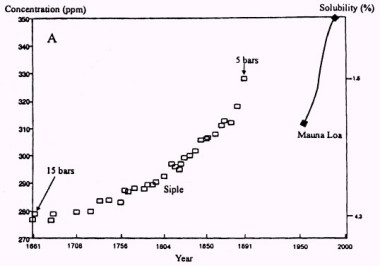 The data from shallow ice cores, such as those from
Siple, Antarctica[5, 6], are widely used as a proof of man-made increase
of CO2 content in the global atmosphere, notably by IPCC[7]. These data
show a clear inverse correlation between the decreasing CO2
concentrations, and the load-pressure increasing with depth (Figure 1
A). The problem with Siple data (and with other shallow cores) is that
the CO2 concentration found in pre-industrial ice from a depth of 68
meters (i.e. above the depth of clathrate formation) was too high. This
ice was deposited in 1890 AD, and the CO2 concentration was 328 ppmv, not
about 290 ppmv, as needed by man-made warming hypothesis. The CO2
atmospheric concentration of about 328 ppmv was measured at Mauna Loa,
Hawaii as later as in 1973[8], i.e. 83 years after the ice was
deposited at Siple. The data from shallow ice cores, such as those from
Siple, Antarctica[5, 6], are widely used as a proof of man-made increase
of CO2 content in the global atmosphere, notably by IPCC[7]. These data
show a clear inverse correlation between the decreasing CO2
concentrations, and the load-pressure increasing with depth (Figure 1
A). The problem with Siple data (and with other shallow cores) is that
the CO2 concentration found in pre-industrial ice from a depth of 68
meters (i.e. above the depth of clathrate formation) was too high. This
ice was deposited in 1890 AD, and the CO2 concentration was 328 ppmv, not
about 290 ppmv, as needed by man-made warming hypothesis. The CO2
atmospheric concentration of about 328 ppmv was measured at Mauna Loa,
Hawaii as later as in 1973[8], i.e. 83 years after the ice was
deposited at Siple.
|
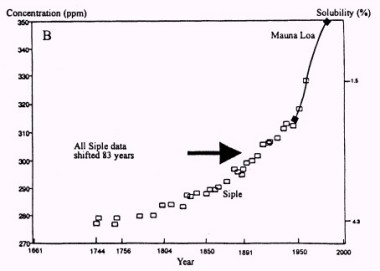 An ad hoc assumption, not supported by any factual
evidence[3, 9], solved the problem: the average age of air was arbitrary
decreed to be exactly 83 years younger than the ice in which it was
trapped. The corrected ice data were then smoothly aligned with the
Mauna Loa record (Figure 1 B), and reproduced in countless
publications as a famous Siple curve. Only thirteen years later, in
1993, glaciologists attempted to prove experimentally the age
assumption[10], but they failed[9]. An ad hoc assumption, not supported by any factual
evidence[3, 9], solved the problem: the average age of air was arbitrary
decreed to be exactly 83 years younger than the ice in which it was
trapped. The corrected ice data were then smoothly aligned with the
Mauna Loa record (Figure 1 B), and reproduced in countless
publications as a famous Siple curve. Only thirteen years later, in
1993, glaciologists attempted to prove experimentally the age
assumption[10], but they failed[9].
|
|
Figure 2
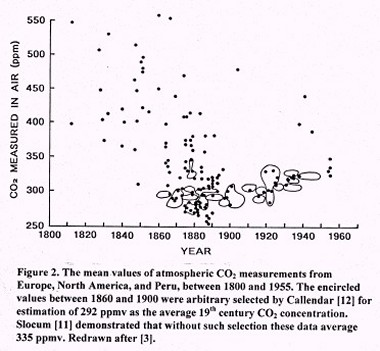 The notion of low pre-industrial CO2 atmospheric level,
based on such poor knowledge, became a widely accepted Holy Grail of climate
warming models. The modelers ignored the evidence from direct measurements of
CO2 in atmospheric air indicating that in 19th century its average concentration
was 335 ppmv[11] (Figure 2). In Figure 2 encircled values show a biased
selection of data used to demonstrate that in 19th century atmosphere the CO2
level was 292 ppmv[12]. A study of stomatal frequency in fossil leaves from
Holocene lake deposits in Denmark, showing that 9400 years ago CO2 atmospheric
level was 333 ppmv, and 9600 years ago 348 ppmv, falsify the concept of
stabilized and low CO2 air concentration until the advent of industrial
revolution [13].
The notion of low pre-industrial CO2 atmospheric level,
based on such poor knowledge, became a widely accepted Holy Grail of climate
warming models. The modelers ignored the evidence from direct measurements of
CO2 in atmospheric air indicating that in 19th century its average concentration
was 335 ppmv[11] (Figure 2). In Figure 2 encircled values show a biased
selection of data used to demonstrate that in 19th century atmosphere the CO2
level was 292 ppmv[12]. A study of stomatal frequency in fossil leaves from
Holocene lake deposits in Denmark, showing that 9400 years ago CO2 atmospheric
level was 333 ppmv, and 9600 years ago 348 ppmv, falsify the concept of
stabilized and low CO2 air concentration until the advent of industrial
revolution [13].
Improper manipulation of data, and arbitrary rejection
of readings that do not fit the pre-conceived idea on man-made global warming is
common in many glaciological studies of greenhouse gases. In peer reviewed
publications I exposed this misuse of science [3, 9]. Unfortunately, such misuse
is not limited to individual publications, but also appears in documents of
national and international organizations. For example IPCC not only based its
reports on a falsified Siple curve, but also in its 2001 report[14] used as a
flagship the hockey curve of temperature, showing that there was no Medieval
Warming, and no Little Ice Age, and that the 20th century was unusually warm.
The curve was credulously accepted after Mann et al. paper published in NATURE
magazine[15]. In a crushing criticism, two independent groups of scientists from
disciplines other than climatology [16, 17] (i.e. not supported from the annual
pool of many billion climatic dollars), convincingly blamed the Mann et al.
paper for the improper manipulation and arbitrary rejections of data. The
question arises, how such methodically poor paper, contradicting hundreds of
excellent studies that demonstrated existence of global range Medieval Warming
and Little Ice Age, could pass peer review for NATURE? And how could it pass the
reviewing process at the IPCC? The apparent scientific weaknesses of IPCC
and its lack of impartiality, was diagnosed and criticized in the early 1990s in
NATURE editorials [18, 19]. The disease, seems to be persistent.
Conclusion
The basis of most of the IPCC
conclusions on anthropogenic causes and on projections of climatic change is the
assumption of low level of CO2 in the pre-industrial atmosphere. This
assumption, based on glaciological studies, is false. Therefore IPCC projections
should not be used for national and global economic planning. The climatically
inefficient and economically disastrous Kyoto Protocol, based on IPCC
projections, was correctly defined by President George W. Bush as fatally
flawed. This criticism was recently followed by the President of Russia
Vladimir V. Putin. I hope that their rational views might save the world from
enormous damage that could be induced by implementing recommendations based on
distorted science.
References
1.
Jaworowski, Z., Stable lead in fossil ice and bones. Nature, 1968. 217: p.
152-153.
2. Mulvaney, R., E.W. Wolff, and K. Oates,
Sulpfuric acid at grain goundaries in Antarctic ice. Nature, 1988.
331(247-249).
3. Jaworowski, Z., T.V. Segalstad, and N.
Ono, Do glaciers tell a true atmospheric CO2 story? The Science of the Total
Environment, 1992. 114: p. 227-284.
4. Shoji, H. and C.C.
Langway Jr., Volume relaxation of air inclusions in a fresh ice core. Journal of
Physical Chemistry, 1983. 87: p. 4111-4114.
5. Neftel, A.,
et al., Evidence from polar ice cores for the increase in atmospheric CO2 in the
past two centuries. Nature, 1985. 315: p. 45-47.
6.
Friedli, H., et al., Ice core record of the 13C/12C ratio of atmospheric
CO2 in the past two centuries. Nature, 1986. 324: p. 237-238.
7.
IPCC, Climate Change - The IPCC Scientific Assessment. ed. J.T.
Houghton et al. 1990, Cambridge University Press: Cambridge, pp.
364.
8. Boden, T.A., P. Kanciruk, and M.P. Farrel, TRENDS
'90 - A Compendium of Data on Global Change. 1990, Oak Ridge National
Laboratory: Oak Ridge, Tennssee, pp. 257.
9. Jaworowski,
Z., Ancient atmosphere - validity of ice records. Environ. Sci. & Pollut.
Res., 1994. 1(3): p. 161-171.
10. Schwander, J., et al.,
The age of the air in the firn and the ice at Summit, Greenland. J. Geophys.
Res., 1993. 98(D2): p. 2831-2838.
11. Slocum, G., Has the
amount of carbon dioxide in the atmosphere changed significantly since the
beginning of the twentieth century? Month. Weather Rev., 1955(October): p.
225-231.
12. Callendar, G.S., On the amount of carbon
dioxide in the atmosphere. Tellus, 1958. 10: p. 243-248.
13.
Wagner, F., et al., Century-scale shifts in Early Holocene atmospheric CO2
concentration. Science, 1999. 284: p. 1971-1973.
14. IPCC,
Climate Change 2001: The Scientific Basis., ed. J.T. Houton et al. 2001,
Cambridge: Cambridge University Press, pp. 892.
15. Mann,
M.E., R.S. Bradley, and M.K. Hughes, Global-scale temperature patterns and
climate forcing over the past six centuries. Nature, 1998. 392: p.
779-787.
16. Soon, W., et al., Reconstructing Climatic and
Environmental Changes of the past 1000 years: A Reappraisal. Energy &
Environment, 2003. 14: p. 233-296.
17. McIntyre, S. and R.
McKitrick, Corrections to the Mann et al. (1998) proxy data base and Northern
hemispheric average temperature series. Energy & Environment, 2003. 14(6):
p. 751-771.
18. Editorial, A., IPCC's ritual on global
warming. Nature, 1994. 371: p. 269.
19. Maddox, J., Making
global warming public property. Nature, 1991. 349: p. 189.
![]()