| Breaking into Politics (1980-1988) | - LINKS - |
| As the 1980s began, the question of global warming had become prominent enough to be included for the first time in some public opinion polls. A 1981 survey found that more than a third of American adults claimed they had heard or read about the greenhouse effect. That meant the news had spread beyond the small minority who regularly followed scientific issues. When pollsters explicitly asked people what they thought of "increased carbon dioxide in the atmosphere leading to changes in weather patterns," nearly two-thirds replied that the problem was "somewhat serious" or "very serious." | |
| Most of these people, however, would never have brought up the subject by themselves. Only a small fraction of Americans understood that the risk of global warming was mainly due to carbon dioxide gas from fossil fuels. Meanwhile a survey of Canadians found that people divided about equally among those who thought climate change was due to some kind of industrial pollution, those who blamed nuclear tests, and those who pointed to space exploration. (The last was no anomaly, for a good many Americans surveyed in the 1990s still imagined that nuclear power and the space program contributed to global warming.) Most people suspected the issue was something they ought to be concerned about, but among the world's many problems it did not loom large. Even those who worried most about pollution were seldom concerned with global affairs, directing their dismay at the oil spill or chemical wastes that endangered a particular neighborhood.(75*) | |
| Among climate scientists, concern continued to rise in the early and mid 1980s. Computer models of the climate were rapidly improving and winning the trust of experts. The modelers now said they were quite confident that a global warming of several degrees would come within the 21st century. To an ordinary citizen, a change of a few degrees might sound trivial. But the scientists understood that it was serious, and science journalists passed along their predictions of sea-level rise and other problems. [Later research confirmed the predictions. For example, a 2004 study estimated that a rise of 3°C sustained over centuries would suffice to melt the Greenland ice cap and put the world’s coastal cities deep underwater.] "Gloomsday Predictions Have No Fault" was how Science magazine summarized the report of one authoritative review panel. The report was noticed even by the New York Times, although only deep on an inside page.(76) Studies of ancient ice, from deep holes drilled in Greenland and Antarctica, backed up the models. For they showed that over past glacial cycles, temperatures and the CO2 content of the atmosphere had gone up and down together in close synchrony. Meanwhile, British and American groups announced that the global warming trend, after pausing between 1940 and the mid-1970s, had resumed with a vengeance. On average the world was hotter in 1980, 1981, and 1983 than in any years as far back as good records went (to the mid-19th century). Russian climate scientists in particular were convinced that global warming was already manifest and urged their foreign colleagues to acknowledge it.(77) |
|
| When their scientific findings met with public indifference, more and more climate scientists around the world concluded that they should work to influence government policy. Along with the traditional scientists' goal of extracting more funds for their own field of study, most weather experts had come to feel that knowledge of climate change would be vitally important for our civilization. Some went further than urging governments to support research. Convinced that the world faced severe global warming within their children's lifetime, they felt called upon to pressure the world's governments to take active steps to reduce greenhouse gas emissions. | |
| These concerns were reinforced and complicated by the ties that some scientists found with other environmentalist issues. An outstanding example was the distinguished biologist George Woodwell, who was a founder and board member of both the National Resources Defense Council and the World Wildlife Fund. Like many biologists and environmentalists, Woodwell decried the destruction of virgin tropical forests. He worried that changes in human use of land could be so socially disruptive "as to be equivalent to the drastic changes in the human condition that a warming of the climate might lead to."(78) The proliferating slash-and-burn peasants who cleared new fields were driving countless species toward extinction, arousing public sympathies for a battle to "save the rainforests." Activists who linked destruction of tropical species with greenhouse warming could make better headway on both issues. Magazine and television images of landscapes going up in smoke began to catch the public eye. Here at last was an immediate, visible connection of CO2 emission with ruined nature (even though the scientific connection to global warming was far from certain). Scientists associated with the Environmental Defense Fund, the World Resources Institute, and similar groups began to issue reports and lobby Congress about global warming.(79) |
|
| The great majority of scientists remained politically inactive. They felt they were doing their job by pursuing research, building up the solid evidence that would tell governments what to do. "I really don't have that much talent to try to influence politicians," one climate scientist explained. "It's much better using my talent, staying as anonymous as possible here, and try to publish a paper... Because once you start getting in the political arena,... you lose credibility."(80) These scientists might answer a phone call from a reporter but they did not offer the confident and snappy answers that journalists wanted. If pressed to offer policy guidance, they preferred to work in government-sponsored study panels and answer questions posed by administrators. Wouldn't official reports by government science agencies, national academies, and international conferences eventually convey information about what actions were appropriate? |
|
| A few scientists felt the world would take too little action on climate change, and too late, unless they personally took the initiative to stir up the public directly. These scientists had to learn some tricks. A Senator might brush off an academic who came to speak with him or his staff, but the Senator paid attention if he saw the scientist on television. Scientists were generally uncomfortable talking with the media. Experience showed how journalists might grab a simple phrase, ignoring the details and qualifications that were inseparable from an accurate scientific account. A few scientists struggled to get a hearing by deliberately wielding public relations techniques, such as crafting approximately accurate but juicy "one-liner" statements that journalists could pick up. Colleagues who had a rigid sense of scientific precision were disgusted. One respected scientist publicly accused his colleagues of publishing "fiction" instead of sound science, speculating that "some of us feel compelled to emphasize the worst case in order to get the attention of the decision makers who control the funding."(81) | |
| There was indeed an ethical dilemma here, as Schneider pointed out when other scientists criticized his approaches to the public. It was not easy "to find the balance between being effective and being honest," he admitted. "But promoting concern over the negative connotations of the greenhouse effect in this media age usually means offering few caveats and uncertainties — at least if you want media coverage. Twenty-second spots on national television programs... do not afford time for hedged statements; and if one is going to influence the public, one simply has to get into the media."(82) | |
| To get a reasonably accurate story to the public, the essential people were professional science writers. There were only a few hundred of them scattered about the world, spending most of their time writing up medical news and other topics remote from geophysics. But many of them were thoughtful people who took their responsibilities seriously. They worked to maintain a symbiotic relationship with leading scientists, each side seeking respect and understanding even as they openly used the other for their purposes. | |
| When it came to deciding what scientific developments were news, American journalists tended to take their cues from the New York Times. The editors of the Times followed the advice of their veteran science writer, Walter Sullivan. A lanky and amiable reporter, Sullivan had frequented meetings of geophysicists ever since the International Geophysical Year of 1957, cultivating a set of trusted advisers in many fields. On the subject of climate, he began listening to scientists like Schneider and, in particular, James Hansen, conveniently located at a NASA institute in New York City. Hansen was energized by his group's computer studies, which showed that warming was likely. In 1981, Sullivan persuaded his editors to feature a story about climate change, based on a scientific article that Hansen sent the reporter a few days ahead of its publication in Science magazine. For the first time the greenhouse effect made page one of the New York Times. Sullivan threatened the world with unprecedented warming and perhaps a disastrous rise of sea level. The newspaper followed up with an editorial, declaring that while the greenhouse effect was "still too uncertain to warrant total alteration of energy policy," it was "no longer unimaginable" that a radical policy change might become necessary.(83) |
|
| This was just one example of a process that brought the perils of climate change into newspapers, magazines, and even occasionally television in the early 1980s. The stories usually rested upon statements by leading scientists including Schneider, Broecker, Nobel Prize winner Melvin Calvin and others. Politicians, ever alert to shifts in what the public was worrying about, took notice.(84) |
|
| The fossil-fuel industries, and other business interests, saw that worries about greenhouse gases might lead to government regulations, following the example of restrictions on smog and spray-can chemicals. Concern also grew among political conservatives, who tended to lump together all claims about impending ecological dooms as left-wing propaganda. When environmentalist ideals had first stirred, around the time of Theodore Roosevelt, they had been scattered across the entire political spectrum. A traditional conservative, let us say a Republican bird-watcher, could be far more concerned about "conservation" than a Democratic steelworker (more recently, at the far end of the traditional Left, Communist nations were the planet's most egregious polluters). But during the 1960s, as the new Left rose to prominence, it became permanently associated with environmentalism. Perhaps that was inevitable. Many environmental problems, like smog, seemed impossible to solve without government intervention. Such interventions were anathema to the new Right that began to ascend in the 1970s. | |
| By the mid 1970s, conservative economic and ideological interests had joined forces to combat what they saw as mindless eco-radicalism. Establishing conservative think tanks and media outlets, they propagated sophisticated intellectual arguments and expert public-relations campaigns against government regulation for any purpose whatever. On global warming, it was naturally the fossil-fuel industries that took the lead. Backed up by some scientists, industry groups developed everything from elaborate studies to punchy advertisements, aiming to persuade the public that there was nothing to worry about. | |
| The message was easily accepted by many among the public, including some who felt deep sympathy for the natural world. Many still found it incredible that mere human industry could seriously interfere with the awesome planetary forces, seeing these as simply an "environment" that happened to contain and sustain living creatures. Others had finally abandoned that viewpoint, only to take up James Lovelock's radical "Gaia hypothesis." Named (in the spirit of the times) after the Greek Earth-goddess, this hypothesis held that the atmosphere was a "contrivance" maintained by the biosphere. There was real scientific content in the idea. But supporters, pushing ahead to assert that life on Earth necessarily and automatically maintains an atmosphere suitable for itself, gave a spuriously scientific gloss to the snug old confidence in the Balance of Nature. (However, some suspected that Gaia would defend "her" balance simply by eliminating humanity itself.) |
|
| The most comforting ideas came from a respected scientist, Sherwood Idso, who published arguments that greenhouse gas emissions would not warm the Earth or bring any other harm to climate. Better still, by fertilizing crops, the increase of CO2 would bring tremendous benefits. His book, Carbon Dioxide: Friend or Foe? came down entirely on the side of Friend. In his opinion, the increase of CO2 "is something to be encouraged and not suppressed."(85) Along the way Idso attacked the "scientific establishment" for rejecting his theories. His scientific and popular publications stirred vehement controversy. | <=Radiation math |
| As environmental and industrial groups and their scientific fellow-travelers hurled uncompromising claims back and forth across a widening political gulf, most scientists found it hard to get a hearing for more ambiguous views. "Our instincts are to fight scientifically fair and to openly admit uncertainty, even when unscientific weapons are deployed," a climate scientist remarked. "This mismatch often leads to an amplified sense of 'scientific' controversy."(86) Journalists in search of a gripping story tended to present every scientific question as if it were a head-on battle between two equal and diametrically opposite sides. Yet most scientists saw themselves as just a bunch of people with various degrees of uncertainty, groping about in a fog. | |
| After Ronald Reagan became President in 1981, environmental issues of every kind became a useful tool for opponents of the Republican administration. Reagan and his supporters could be counted on to embarrass themselves with a see-no-evil approach to any industrial activity. The greenhouse effect question now became strongly polarized along political lines. You could usually guess whether someone thought global warming was likely to happen, if you knew what they thought about any sort of government environmental regulation. | |
| The fires of public interest were stoked by Congressional hearings (promoted especially by Albert Gore, who had taken an early interest in the topic). Also newsworthy was a 1983 controversy over an alarming report issued by the Environmental Protection Agency, set against a calming report from the National Academy of Sciences. It was largely thanks to this political skirmishing that popular magazines and newspapers reported on the greenhouse effect repeatedly during the early 1980s. |
|
| Far greater attention went to other atmospheric changes. Air pollution remained a problem in many cities, joined now by dire warnings about "acid rain." During the 1970s, scientists had begun to report that rain carrying sulfates emitted by power plants and other industries was devastating fish and forests, and even the paint on houses, in certain vulnerable regions. Coal-burning industries quieted local protests by building their smokestacks hundreds of feet high, but that only spread the damage more widely. In the 1980s, the problem stirred extensive political controversy and even international recriminations. Images of moribund stands of trees and decaying statues, attacked by sulfuric acid derived from smokestacks thousands of miles upwind, argued that industrial emissions could be a problem for everyone, everywhere. The excellent environmentalist slogan, "Think globally, act locally," was no use when power plants half a continent away sickened your neighborhood lake.(87) Some environmentalists proclaimed that acid rain would eventually damage the entire planet. And this was not the worst global threat. |
|
| In 1980, scientists announced a new theory for what had killed off the dinosaurs tens of millions of years ago: an asteroid had struck the Earth and clouded the atmosphere for years, freezing plants and animals. The theory fascinated the public, perhaps less because it addressed dinosaurs than because it addressed extinction. That struck a resonance with deep-set fears of nuclear war, which had revived around the time Reagan took office. As one scientist remarked, the asteroid theory "commanded belief because it fit with what we are prepared to believe... Like everyone else... I carry within my consciousness the images of mushroom clouds." The idea of global extinction caused by a blast coming from the sky, he said, "feels right because it fits so neatly into the nightmares that project our own demise."(88) | <=World winter |
| On Hallowe'en 1983, a group of respected atmospheric scientists held a press conference to make a carefully orchestrated announcement about a different climate catastrophe. They had come to fear that soot from cities torched in a nuclear war might blacken the atmosphere as much as an asteroid strike. Years of cold and dark might jeopardize the survival of all humankind. Didn't that prove that launching a nuclear attack, even if the other side never fired back, would be literally suicidal? So maintained a group of well-known experts, including Western Europeans and Russians as well as Americans, and most prominently Carl Sagan — a chief spokesperson for the group because his fame, much more as an astronomy popularizer than as an atmospheric scientist, could attract television cameras. The scientists' aim was frankly political. They meant to reinforce a public movement that was just then calling on the United States to reduce its inventory of bombs. Meanwhile the announcement added another layer to public imagination of calamitous global climate change. | <=World winter |
| Scientific discussions of climate catastrophe from an asteroid strike or nuclear war are described more fully in a supplementary essay on Wintry Doom | |
| Other scientists questioned the scientific reasoning, and the Reagan administration heaped scorn on its critics. Even before the scientific study was published, government scientists among the authors felt pressure to keep a low profile. The pressure backfired. Forbidden to include the words "nuclear war" in the title of their paper, one of them came up with an evocative phrase — "nuclear winter." Sagan and others answered their critics in sharp partisan debate. From the outset, a person's views on the climate scientists' predictions could usually be guessed from the person's views about nuclear disarmament. Newspapers, magazines, and even television gave the battle close attention. From this point on, computer calculations of the effects of dust and the fragility of the atmosphere were inescapably entangled in high national politics.(89) |
|
| While these issues were being thrashed out to exhaustion, public interest in global warming flagged. Around 1984 the coverage of the issue, as measured by numbers of books and magazine and newspaper articles, dropped back.(90*) The spell of unusually bad weather in the early 1970s was fading from memory, and exclamations about an imminent catastrophe waned. Besides, the Clean Air Act plus the ban on ozone-destroying chemicals suggested to the public (as politicians intended) that the most urgent dangers were well in hand. Anyway the news media rarely sustain a high level of anxiety about any topic for more than a few years. Editors dislike publishing article after article on the same subject in the absence of striking new events, for repetition quickly bores the public. | |
| The attention of the minority who continued to worry about planetary doom likewise turned to other problems. Such movements, including fears of nuclear war, tended to rise and fall in decade-long cycles. Back in the mid 1960s, when Cold War tensions had dwindled, many committed activists had turned from their grueling campaign against nuclear weapons to spend their energies on environmentalist causes. Now, with the Reagan administration trumpeting its anti-Soviet belligerence, many activists turned their attention from the environment back to the Cold War. The "nuclear winter" controversy was a milestone in the transition to agitation for a "nuclear freeze," a halt in production of nuclear weapons.(91) |
|
| Fears of climate change could not hold a candle to fears of nuclear war, nor even to the mounting public concern about peaceful nuclear reactors with their risks of explosions and radioactive wastes. Climate change did include some of the factors that are effective in rousing public anxiety. People are not particularly afraid of risks that seem familiar and within their personal control, feeling only too little anxiety as they smoke or race a red light. Climate change offered less comfortable risks. Dread of the unknown was fostered by a feeling that great forces were at work, operating in a hidden fashion, mysterious even to scientists. Worse, the threat was something new, and growing, and far beyond anyone's personal control. But nuclear energy had similar factors in at least equal strength, plus many more hooks digging into people's minds. Uncanny rays and poisons, menacing authority figures (mad scientist, belligerent general, cold-blooded corporate executive), images of Hiroshima, above all the actual existence of nuclear missiles that might at any moment descend on your home — when such things came back to mind, they easily displaced abstract worries about a few degrees of warming in the next century.(92) | |
| Although climate arguments faded from the news, they had left a residue in the public mind. The idea that nuclear war might bring global environmental disaster had been familiar for decades as a science-fiction scenario. From the start it had brought to mind far older tales — the Ice-Winter at the world's end in Nordic myth, intertwined with the Bible's apocalyptic rain of fire. Scientific calculations of "nuclear winter" and other devastation now made it hard to dismiss such visions as fantasy. We cannot observe the deep levels beyond logic where ideas connect in the minds that make up the public, but we can guess at what was happening there. Probably for many people the dread connected with nuclear war, a complex of images and attitudes covering the entire range from politics to paranoia, became loosely associated with feelings about climate change. The idea that humankind itself might trigger global atmospheric change — as if in punishment for our transgressions against the natural order — was looking more than ever like a sober possibility. | |
| This attitude was nailed down in 1985 when a British group announced their discovery of a "hole" in the ozone layer over Antarctica. The discovery could have been made years earlier if scientists had been more on the lookout for ways that a small human production of chemicals could ravage the atmosphere. The apparent culprit was again CFCs, banned from American spray cans but still widely produced around the world for a variety of functions. Inevitably a new controversy began, for again industrial interest groups automatically denied that any of their products could be hazardous. Reagan administration officials reflexively backed the industries against hostile environmentalists. | |
| This time the denials were short-lived. Within two years experts were convinced. For the public, television showed colorful maps displaying the lack of ozone. A few scientists warned that the same chemicals that destroyed ozone could add to global warming, but that was mostly overlooked. The immediate threat was the ozone destruction, which would increase skin cancers and bring many other biological harms. But many members of the public got ozone depletion confused with global warming, as if the two problems were one. Ignorant of the science, the majority only sensed obscurely that atmospheric changes were looking more dangerous. |
|
| The public took a strong interest in the "ozone hole," forcing a political response. The outcome was an international agreement, forged in Montreal in 1987, to gradually halt production of ozone-destroying substances. If the agreement was enforced, and if it was extended as industry produced new chemicals, that would settle the ozone problem. It would only slightly retard global warming, but the agreement proved that the world could take effective action against an atmospheric threat — if the threat was sufficiently convincing, immediate, and well publicized. | =>Government =>International |
| The Summer of 1988 TOP OF PAGE | |
| While the public was assimilating the lesson of the ozone hole — the fact that human activity could change elements of the atmosphere both seriously and quickly — scientists were assimilating the latest research. A new breed of interdisciplinary studies was showing that even a few degrees of warming might have harsh consequences, both for fragile natural ecosystems and for certain agricultural systems and other human endeavors. Gradually it was becoming apparent that even a degree or two of warming could devastate many of the world's coral reefs, that tropical diseases would invade new territory, and so forth. Still more troubling, it seemed that the entire climate system could change more rapidly than most experts had suspected. A mere couple of decades might bring a shocking surprise. In particular, the circulation of water in the North Atlantic might shift abruptly, which would bring not warmth but severe cooling to the region. |
|
| These research findings began to show up sporadically in articles addressed to the science-attentive public. Broecker in particular issued warnings, as when he wrote in Natural History magazine that we had been treating the greenhouse effect as a "cocktail hour curiosity," but now "we must view it as a threat to human beings and wildlife." The magazine's editors went even beyond that, putting a banner on the cover that read, "Europe beware: the big chill may be coming." Might global warming bring a change in ocean currents that would, paradoxically, make London as cold as Labrador? (Broecker was annoyed, for in fact he had given little sustained thought at that time to whether human activities might cause damaging changes in ocean currents.)(93) The notion that a climate catastrophe might descend swiftly was now on the world's public agenda. |
|
| The idea was not widely heeded, even by the small minority of people who read about such matters. The risk that global warming would bring, for instance, an oceanic change that could freeze Europe, was just one small item among many futuristic concerns. Far more was written about the potential threat of radioactive wastes from nuclear power plants, the perils of genetically modified plants, the remote but exciting possibility of bombardment by a giant asteroid, and so forth. | |
| The most visibly outspoken climate expert was James Hansen. In 1986 and 1987, he created a minor stir among those alert to the issue when he testified before a Congressional committee. He insisted that global warming was no vague and distant possibility, but something that would become apparent within a decade or so. His group of climate modelers claimed that they could "confidently state that major greenhouse climate changes are a certainty." In particular, "the global warming predicted in the next 20 years will make the Earth warmer than it has been in the past 100,000 years."(94*) | 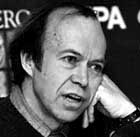 Jim Hansen |
| News reporters gave only a little attention to Hansen's November 1987 Congressional testimony, and they did not quote Broecker’s January 1987 statement at all, as newspapers filled their columns with stories of a severe winter storm. A report a few months later that the 1980s were proving to be the hottest years ever recorded did make it into the New York Times (March 29) but only on an inside page. As the summer of 1988 began, global warming remained below the threshold of public attention. Roughly half the American public were not even aware of the problem. Those who had heard about warming mostly saw it as something that the next generation might need to worry about, or might not. |
|
| A shift of views had been prepared, however, by the ozone hole, acid rain, and other atmospheric pollution stories, and by a decade of agitation on these and many other environmental issues, and by the slow turning of scientific opinion toward stronger concern about global warming. Only a match was needed to ignite the worries. This is often the case for matters of intellectual concern. No matter how much pressure builds up among concerned experts, some trigger is needed to produce an explosion of public concern. | |
| The trigger came in the summer of 1988. Already by June, heat waves and drought had become a severe problem, drawing public attention to the climate. Many newspaper, magazine, and television stories showed threatened crops and speculated about possible causes. Hansen raised the stakes with deliberate intent. "I weighed the costs of being wrong versus the costs of not talking," he later recalled, and decided that he had to speak out. By arrangement with Senator Timothy Wirth, Hansen testified to a Congressional hearing on June 23. He had pointed out to Wirth's staff that the previous year's November hearings might have been more effective in hot weather. Wirth and his staff decided to hold their next session in the summer, although that was hardly a normal time for politicians who sought attention.(95) |
|
| Their luck was good. Outside the room, the temperature that day reached a record high. Inside, Hansen said he could state "with 99% confidence" that a long-term warming trend was underway, and he strongly suspected that the greenhouse effect was to blame. Relying not only on his computer model work but also on elementary physical arguments, he explained that global warming was liable to bring more frequent storms and floods as well as life-threatening heat waves.(96*) | <=>Simple models <=Models (GCMs) |
| Talking with reporters afterward, Hansen said it was time to "stop waffling, and say that the evidence is pretty strong that the greenhouse effect is here." Some news reports confused Hansen's assertions, reporting that he was virtually certain that the greenhouse effect was the cause of the current droughts.(97) The story was no longer a scientific abstraction about an atmospheric phenomenon: it was about a present danger to everyone from farmers to the owners of beach houses. |
|
| The timing was right, and the media leaped on the story. Hansen's statements, especially that severe warming was likely within the next 50 years, got on the front pages of newspapers and were featured in television news and radio talk shows.(98*) Some respected scientists publicly rebuked Hansen, saying he had gone far beyond what scientific evidence justified.(99) But the problem lay not so much with his explicit statements as with his tone and the way the media reacted to it. | |
| The story grew as the summer of 1988 wore on. Thanks to the heat and drought, reporters descended unexpectedly upon an international conference of scientists held in Toronto at the end of June. Their stories prominently reported how the world's leading climate scientists declared that atmospheric changes were already causing harm, and might cause much more, demanding vigorous government action to restrict greenhouse gases. Meanwhile the heat waves and droughts continued, the worst since the Dust Bowl of the 1930s, devastating many regions of the United States. Old people died in cities, shops ran out of air conditioners, many communities imposed water rationing, there were fears of a new Dust Bowl, and the level of the Mississippi River fell so low that barge traffic was paralyzed. On top of that came "super hurricane" Gilbert and the worst forest fires of the century. Cover articles in news magazines, lead stories on television news programs, and countless newspaper columns offered dramatic images of sweltering cities, sun-blasted crops, and Yellowstone National Park aflame. |
|
| Reporters asked, were all these caused by the greenhouse effect? Simply from endless repetition of the question, many people became half convinced that human pollution was indeed to blame for it all. The images triggered the anxieties that had been gradually building up about our interference with weather. As one scholar who studied these events put it, "Whether regarded as a warning signal or a metaphor of a possible future, the weather unleashed a surge of fear that brought concentrated attention to the greenhouse effect."(100) | |
| News reports often failed to explain that scientists never claimed that a given spell of weather was an infallible reflection of global warming. Schneider, who also testified in Congressional hearings and was often quoted, suggested that "the association of local extreme heat and drought with global warming took on a growing credibility simply from its repeated assertion." He worried that the media exaggerations would bring the public to dismiss climate science as unreliable when the next cold, wet season arrived.(101) But Schneider, Hansen, and their fellows could only be pleased that the issue had at last gotten into the spotlight. "I've never seen an environmental issue mature so quickly," an environmental advocate remarked, "shifting from science to the policy realm almost overnight."(102) | |
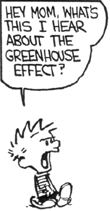
| The number of articles on climate listed in the Readers' Guide, which had held steady since the mid 1970s, took a quantum leap upward. Between spring and fall of 1988 the number of articles listed abruptly tripled, and over following years remained at the new level. The number of American newspaper articles on global warming jumped tenfold in 1988 over what was published in 1987 (which was already well above the negligible number published a decade earlier) and continued to rise in following years.(103*) For the first time, global warming showed up repeatedly in the most widely read of all American media, the comic strips. In the second half of 1988 the problem got a mention in such highly popular, and normally scarcely topical, strips as "Kathy," "Calvin and Hobbes," "Little Orphan Annie" and even "Dick Tracy." Their creators could take it for granted that readers understood their clever remarks about warming. | |
| A killing heat wave in China, a ghastly flood in Bangladesh, and spectacular episodes of ocean pollution in Europe gave climate worries a global reach. The Toronto meeting, and many other avenues of communication among environmentalists and scientists, helped spread concern internationally. In Germany, to take one case, a subgroup of the German Physical Society had already prepared attitudes with a 1986 report carrying the dramatic title, "Warning of the Impending Climate Catastrophe." Although most scientists quickly backed away from the apocalyptic tone, from then on the phrase "Klimacatastrophe" permeated Germany's media and public consciousness. Attention mounted steadily through 1988 and into the early 1990s.(104) |
|
| In September 1988 a poll found that 58% of Americans recalled having heard or read about the greenhouse effect. It was a big jump from the 38% that had heard about it in 1981, and an extraordinarily high level of public awareness for any scientific phenomenon. Most of these citizens recognized that "greenhouse effect" meant the threat of global warming, and most thought they would live to experience climate changes.(105) In other polls, a majority of Americans said that they thought the greenhouse effect was "very serious" or "extremely serious," and that they personally worried "a fair amount" or even "a great deal" about global warming. Fewer than one-fifth said they worried "not at all" or had no opinion.(106*) | |
| Politicians could not overlook such strong public concern — nor could they overlook the heat in the capital city itself, where the summer of 1988 was the hottest on record.(107) Congress saw a flurry of activity as some 32 bills dealing with climate were introduced.(108) Whether or not attention could be sustained at such a high level, global warming had finally won a prominent and enduring place on the public agenda. |
|
| Now that nuclear war concerns were fading as the Soviet Union decayed, people striving to reform the world could redirect their energies toward environmental issues. The environmental movement, which had found only occasional interest in global warming, now took it up as a main cause. Groups that had other reasons for preserving tropical forests, promoting energy conservation, slowing population growth, or reducing air pollution could make common cause as they offered their various ways to reduce emissions of CO2. Greenpeace, the Environmental Defense Fund, the Sierra Club, and many other organizations made reduction one of their top priorities.(109) Adding their voices to the chorus were people who looked for arguments to weaken the prestige of large corporations, and people who wanted to scold the public for its wastefulness. For better or worse, global warming became identified more than ever as a "green" issue. In principle it could have been viewed instead as a technical problem of global engineering (how should we manage the planet's climate?). But pollution and weather disasters brought in high economic stakes and potent imagery. Global warming was no longer just a research question, but a subject of hostile political maneuvering. | |
| In the long perspective, it was an extraordinary novelty that such a thing became a political question at all. Global warming was invisible, no more than a possibility, and not even a current possibility but something predicted to emerge only after decades or more. The prediction was based on complex reasoning and data that only a scientist could understand. It was a remarkable advance for humanity that such a thing could be a subject of widespread and vehement debate. | |
| Discourse hads grown more sophisticated in many way. That may have been partly because of the steady accumulation of knowledge, and also because the public in wealthy countries had become better educated (a larger fraction of young people was now going to college than had gone to high school at the start of the century). Furthermore, stable times encouraged people to plan farther into the future than in earlier eras. So too, perhaps, did the unexpected addition of decades to the average lifespan. | |
| The debate was also made possible by the new relationship that had grown between people and the atmosphere, indeed with all nature. Global warming, along with the ozone hole and acid rain and smog, had obscurely entangled the atmosphere in politics. The winds and clouds had taken on (as one observer later mused) "a vaguely sinister cast... It was perfect weather for postmodernists: inescapably self-referential."(110) In an influential New Yorker magazine article and book, nature writer Bill McKibben announced "The End of Nature." In 1900, nature had surrounded our towns and fields. People saw it partly as a nurturing setting for humanity, and partly as a savage "outside" to be tamed and civilized. By the 1970s, more and more people had come to see nature the other way around, as a preserve surrounded by civilization. Now the preserve itself had been overrun. | |
| It was not just that our pollution invisibly invaded the atmosphere. The feeling of contamination by radioactive fallout and acid rain was bad enough, yet those seemed like reversible additions, superimposed upon the old natural system. The greenhouse effect was different, McKibben declared, for "the meaning of the wind, the sun, the rain — of nature — has already changed." Now every cloud, every breeze, bore the imprint of human hands. The taint was not only around us but within us. People bowed to sadness and guilt as we realized that we had "taken a hammer to the most perfectly proportioned of sculptures."(111) | |
| After 1988 TOP OF PAGE | =>after88 |
| After the flood of global warming stories in the summer of 1988, media attention inevitably declined as more normal weather set in. It is typical of topics in the news that unless they regularly produce something new and exciting, they will not linger for long near the top of the list of concerns. Even for a potential danger, readers will become discouraged or simply bored when nothing immediate is done, and editors will look for something novel to cover. It was still less likely that interest in climate change would remain high when weather is notoriously fickle — the winter of 1989 was a particularly cold one. The climate change story also lacked an interesting enemy, a devil (other than ourselves) to blame for the world's woes.(112) But even if an issue is no longer in the forefront of everyone's mind, it can remain present. Although press coverage of global warming sank after its peak in the summer of 1988, it now fluctuated around a much higher average level than in the early 1980s.(113) | |
| The issue had entirely caught the attention of one vital section of the public — the scientific community. It is impossible to judge how far scientists altered their research plans because of aroused public interest. Scientists were far more aware than the general public of how the scientific findings of the past decade, the supercomputer calculations and ice core measurements and data on rising global temperatures, had raised the plausibility of greenhouse warming models. At a minimum, the big step up in public interest suggested that anyone studying the topic would get a better hearing when requesting funds, recruiting students, and publishing. | |
| For whatever reason, climate research topics now became far more prominent in the scientific community itself. Prestigious general-science journals like Nature and Science, and popularizing magazines like the New Scientist, had published perhaps one or two significant climate articles per year in the early and mid 1980s. Now they began to publish one almost every week. The higher level was sustained over the following years. This was probably a main reason why the general press, whose science reporters took their cue from scientists and their journals, continued to carry numerous articles on climate change. | |
| In the specialized scientific journals themselves, citations to topics like "greenhouse gases" and "climate modeling" had held fairly steady at a low level through the mid 1980s, but after 1988 they rose spectacularly. References to the subject continued to rise ever higher through the 1990s. Citations to climate change in social-science journals began to soar at the same time.(114) Meanwhile scientific conferences proliferated, ranging from small workshops to highly publicized international events, so numerous that nobody could attend more than a fraction. |
|
| Environmentalist organizations continued to make global warming a main focus, carrying on with sporadic lobbying and advertising efforts to argue for restrictions on emissions. The environmentalists were opposed, and greatly outspent, by industries that produced or relied on fossil fuels. Industry groups not only mounted a sustained and professional public relations effort, but also channeled considerable sums of money to individual scientists and small conservative organizations and publications that denied any need to act against global warming.(115) This effort followed the pattern of scientific criticism and advertising that industrial groups had used to attack warnings against ozone depletion and acid rain (not to mention automobile smog, tobacco smoke, etc.). Although those campaigns had been discredited after a decade or two, fair-minded people were ready to listen to the global warming skeptics. | |
| It was reasonable to argue that intrusive government regulation to reduce CO2 emissions would be premature, given the scientific uncertainties. Conservatives pointed out that if something did have to be done, the longer we waited, the better we might know how to do it. They also argued that a strong economy (which they presumed meant one with the least possible government regulation of industry) would offer the best insurance against future shocks. Activists replied that action to retard the damage should begin as soon as possible, if only to gain experience in how to restrict gases without harming the economy. They argued hardest for policy changes that they had long desired for other reasons, such as protecting tropical forests and removing government subsidies that promoted fossil fuel use. | |
| The topic had become still more politicized. A study of American media found that in 1987 most items that mentioned the greenhouse effect had been feature stories about the science, whereas in 1988 the majority of the stories addressed the politics of the controversy. It was not that the number of science stories declined, but rather that as media coverage doubled and redoubled, the additional stories moved into social and political areas.(116) Another study similarly found that before 1988, some three-quarters of the articles on climate change in leading American newspapers described the problem and its causes, whereas by the early 1990s, more than half of the far more numerous articles focused on claims about proposed remedies or on moral judgments. Before 1988, the journalists had drawn chiefly on scientists for their information, but afterward they relied chiefly on sources who were identified with political positions or special interest groups.(117) Meanwhile the interest groups themselves, from environmentalists to automobile manufacturers, increasingly advertised their views on global warming. | |
| Both scientific and political arguments were thoroughly entangled with broader attitudes. Public support for environmental concerns in general seems to have waned after 1988. Along with the natural exhaustion of all movements once they have achieved some of their goals, the ignominious collapse of Soviet Communism greatly increased the confidence of those who opposed government intervention in economic affairs. Actually it was in the Soviet Union, more than anywhere, that unrestricted pollution had shown that the horrifying predictions of environmentalists could come true. But people who sought to restrict greenhouse gases could not shake loose from the association of restrictions with over-centralized command of the economy. | |
| Many believed that only good could come of whatever the triumphant free-market economy produced, including greenhouse gases. A few scientists sustained the old argument that the "enrichment" of the atmosphere by CO2 would be a positively good thing for agriculture and for civilization in general. Some thought global warming itself would be all for the better. Russians in particular, in their bleak winters, looked forward to an improved climate. At the end of 1988, the senior Russian climatologist Mikhail Budyko told an international conference of scientists that global warming would make tundra regions fertile — an argument received, an American scientist recalled, like "swearing in the church." (Budyko did agree however that whatever the effects of global warming in the 21st century, over the longer term it could well be dangerous.)(118*) | <=Biosphere |
| The main argument offered against regulating greenhouse gases was simply to deny that warming was likely to come at all. A few scientists insisted that the statistics of record-breaking heat since the 1970s were illusory. The most prominent of these skeptics was S. Fred Singer, who retired in 1989 from a distinguished career managing government programs in weather satellites and other technical enterprises, then founded an environmental policy group funded by conservative foundations. Among other objections, Singer argued that all the expert groups had somehow failed to properly account for the well-known effects of urbanization when they compiled global temperature statistics. (119) Other skeptics pointed to analysis of satellite data that failed to show warming (debate continued all through the 1990s before studies demonstrated that the satellite instruments gave a poor measure of surface warming). Some conceded that global temperatures had risen modestly, but held that the rise was just a chance fluctuation. After all, for centuries there had been gradual drops and rises of average temperature around the North Atlantic, in particular. Why couldn't the next decades experience a cooling? They entirely disbelieved the computer models that predicted warming from the greenhouse effect. All of these arguments had at least some validity, and the citizen with a taste for science could pick up the ideas from occasional semi-popular articles. | <=Modern temp's |
| Especially well founded were the doubts about computer model predictions. Different models gave different predictions for just how a given locality would be affected by global warming (or at any rate by "global climate change," the more general phrase that cautious writers were adopting). Still, all the models agreed pretty well on the projected average warming.. The main trend turned out to faithfully confirm the predictions of old and simple hand-waving arguments. Yet when critics set a strict scientific standard, demanding solid proof that no crucial effect had been left out, the modelers had to admit that many uncertainties remained and they had much work to do. | |
| The science remained ambiguous enough to leave scientists, like everyone else, susceptible to influence from their deepest beliefs. The wish to personally preserve and improve the world, often a strong motivation for those who chose scientific careers, was not restricted to supporters of environmental regulations. Journalists remarked that the scientific critics of global warming were mostly strong political conservatives, deeply opposed in principle to extensions of government power. Their intense skepticism about global warming could seem, as one journalist noticed, to grow less from research than from a "distaste for any centralized government action" and an almost "religious" faith that humanity would not be laid low.(120) Conservatives in return advised that the most strident official and scientific warnings about global warming seemed designed to promote government action, not only on behalf of the environment but on behalf of empowering bureaucracies and climate researchers themselves. Yet no scientists claimed that their chief concern was political. What would ultimately matter was whether global warming was truly a menace. | |
| The technical criticism most widely noted in the press came in several brief "reports" — not scientific papers in the usual sense — published between 1989 and 1992 by the conservative George C. Marshall Institute. The anonymously authored pamphlets came with the endorsement of Frederick Seitz, former head of the National Academy of Sciences, an ageing but still highly admired scientist whose expertise had been in solid-state physics. The reports assembled a well-argued array of skeptical scientific thinking, backed up by vocal support from a few reputable meteorologists. Concerned that proposed government regulation would be "extraordinarily costly to the U.S. economy," they insisted it would be unwise to act on the basis of the feeble global warming theories and data.(121*) |
|
| Opponents of regulation made sure that the technical uncertainties described in the Marshall Institute reports and elsewhere became widely known. In 1989 some of the biggest corporations in the petroleum, automotive, and other industries created a Global Climate Coalition, whose mission was to disparage every call for action against global warming. Operating out of the offices of the National Association of Manufacturers, over the following decade the organization would spend tens of millions of dollars. It supported lectures and publications by a few skeptical scientists, produced slick publications and videos and sent them wholesale to journalists, and advertised directly to the public every doubt about the reality of global warming.(122) The criticism fitted well with the visceral distrust of environmentalism that right-wing political commentators were spreading. The scientific criticism particularly influenced President George H.W. Bush’s administration. Enough of the public was likewise sufficiently impressed by the skeptical advertising and news reports, or at least sufficiently confused by them, so that the administration felt free to avoid taking serious steps against global warming. |
|
| Scientists noticed something that the public largely overlooked: the most outspoken scientific critiques of global warming predictions did not appear in the standard scientific publications, the "peer-reviewed" journals where independent scientists reviewed every statement before publication. The critiques tended to appear in venues funded by industrial groups, or in conservative media like the Wall Street Journal. Most climate experts, while agreeing that future warming was not a proven fact, found the critics' counter-arguments dubious, and some publicly decried their reports as misleading "junk science."(123) Other experts, Hansen for one, exclaimed that "wait and see" was no way to deal with the "climate time-bomb." Going beyond calls to limit greenhouse gas emissions, he concluded that "governments must foster conditions leading to population stabilization."(124) On several points open conflict broke out between some scientists, with acrimonious and personalized exchanges.(125) | |
| To science journalists and their editors, the controversy was confusing, but excellent story material. The American media in the late 1980s gave climate change substantial coverage, especially the New York Times, which still largely set the agenda for other American media. News magazines published many stories, although television gave only light coverage. Many reporters took a skeptical view of the administration's position. Outside a few deeply conservative media like the Wall Street Journal and right-wing talk radio programs, journalists tended to accept that greenhouse warming was underway. Following the usual tendency of the media to grab attention with dire predictions, a majority of the reports suggested that the consequences of global warming could be cataclysmic, with devastating droughts, ferocious storms, waves attacking drowned coastlines. In reality, the worst consequences were expected for certain vulnerable developing nations, but as usual the America media gave little attention to the rest of the world. Many stories optimistically suggested that technological progress would solve the problem. Journalists did not often emphasize that citizens might have to make hard choices between conflicting values. | |
| Seeking the excitement of conflict, as was their wont in covering almost any subject, some reporters wrote their stories as if the issue were a simple fight between climate scientists and the Republican administration. Many other reports presented the issue as if it were a quarrel between two diametrically opposed groups of scientists. Journalists often sought an artificial balance by matching "pro" with "anti" scientists, one against one.(126) | |
| When scratch surveys sought the real opinions of climate scientists,, most of them revealed mixed feelings. A modest majority believed that global warming was very probably underway. It was only a small minority who insisted there was no problem, while at least as many insisted that the threat was acute. Amid the publicized controversy, it was hard to recognize that there was in fact a consensus, shared by most experts — global warming was quite probable although not certain. Scientists agreed above all that it was impossible to be entirely sure. The media got that much right, for most reports in the early 1990s emphasized the lack of certainty. |
|
| Recognizing the need for a better representation of what scientists did and did not understand, climate scientists and government bureaucrats formed an Intergovernmental Panel on Climate Change (IPCC). The IPCC’s committees managed to forge consensus views that almost every expert and official could accept, and published them as definitive reports. The first IPCC report, released in 1990, rehearsed the usual ambiguous warnings about the possibilities of global warming. This was nothing exciting or surprising, and the report got hardly any newspaper coverage.(127)Yet scientific opinion was shifting, although so gradually that it would take a special event to make that appear as "news." | |
| An opportunity came with the second IPCC report, issued late in 1995. The somnolent public debate revived on the news that the panel had agreed that the world really was getting warmer, and that the warming was probably caused at least in part by humanity. Although many scientists had been saying that for years, this was the first formal declaration by the assembled experts of the world. It was page-one news in many countries, immediately recognized as a landmark in the debate. (Further warnings from the panel, such as the possibility of climate "surprises," were less noted.)(128*) Better still for reporters, the report stirred up a nasty controversy, for a few critics cast doubt upon the personal integrity of some IPCC scientists. The principle target, a main author of the report, remarked that he had to spend the better part of the following summer dealing with journalists and e-mails.(129) | <=International |
| Even more newsworthy was the international Kyoto Climate Conference, scheduled for December 1997. Here was where governments would make real economic and political decisions on the use of fossil fuels. The administration of President Bill Clinton made a bid for public support for a treaty, holding a well-publicized conference of experts on climate change in October. Editors saw a story line of conflict developing as they anticipated the Conference. News reports were further stimulated by advertising campaigns and other intense public relations efforts, funded by environmental organizations on the one hand, by the Global Climate Coalition of industrial corporations on the other. Television stories dealing with global warming jumped from a mere dozen in July-September to well over 200 in October-December. Most of the stories asserted that global warming was underway, with barely a tenth including any expression of doubts. Yet after the Conference the wave of attention faded away as quickly as it had come, leaving little change in public opinion. People mostly stuck to the positions they had adopted around 1988 if not earlier.(130) | |
| The increasingly unequivocal and occasionally activist stance of many climate scientists continued to be opposed by a respectable minority. Some of the critics argued publicly that the 20th century's global warming (if it existed at all) had come only because the Sun had temporarily become more active. By the end of the 1990s they had some plausible data and theories to back them up, but most experts felt the case was weak. Even some of the scientist critics admitted that, whether or not rising CO2 levels had brought warming already, eventually the greenhouse effect must be felt. Some went on to claim that this would bring net benefits. In any case the only reasonable policy, a prominent critic insisted, "is to adapt to climate change."(131) As the editors of Nature magazine remarked in 2000, "The focus of the climate change debate is shifting from the question of 'will there be climate changes?' to 'what are the potential consequences of climate change?'"(132) | <=Solar variation |
| Skeptics continued to insist in every available forum that adverse consequences were so uncertain, and anyway so distant, that it would be economic folly to restrict fossil fuel use anytime soon. But support for their arguments was waning even among industrial leaders. Listening to the international community of scientists (and perhaps some of their own in-house experts), they concluded that any prudent business ought to lay plans for the most likely contingency — namely, a changing climate, with irresistible public pressure for action. Prominent corporations began to pull out of the Global Climate Coalition. By 2000 many publicists were abandoning the claim that there was no global warming problem, and shifted to arguments about the most business-friendly way to ameliorate it. More efficient use of fossil fuels, alternative energy sources (not forgetting nuclear), and changes in forestry and agriculture all held great promise. |
|
| In between episodes of debate, the issue occupied little of the public's attention. Television weather news, the only place where much of the public might get climate information on a regular basis, preferred to avoid the issue altogether. It was too complex, too highly politicized, and perhaps too depressing for what were basically entertainment programs. As one reporter put it, global warming was "not the kind of bad news people want to hear in a weather forecast."(133) Most politicians likewise saw little to gain by stirring up the issue. In the absence of manifest public concern, why pay attention to such an issue (especially if it went against short-term industrial interests)? Even Gore mentioned global warming only briefly during his run for the presidency in 2000. |
|
| Occasionally science reporters would find a news hook for a story. The press took mild notice when experts announced that 1995 was the warmest year on record for the planet as a whole, and when 1997 broke that record, and 1998 yet again. The impact was muted, however, since these figures were averages, and the warming happened to be most pronounced in remote ocean and arctic regions. Some smaller but important places — in particular the U.S. East Coast, with its key political and media centers — had not experienced the warming that was evident in some other regions in the last decades of the century. | <=Modern temp's |
| Reports of official studies by government or international panels each had their day in the limelight, but rarely more than a day. Stories made more of an impression if they dealt with something visible, as when ice floes the size of a small nation split off from the Antarctic ice shelves.(134) Other chances to mention global climate change came in stories about heat waves, floods, and coastal storms, especially when the events were more damaging than anything in recent memory. In fact, any of these widely reported incidents might have had nothing to do with global warming. The most sensational stories had little scientific significance in themselves. Yet for symbolically conveying what scientists did believe, the incidents could be truer than any dry array of data. For example, when tourists who visited the North Pole in August 2000 told reporters that they had found open water instead of ice, news stories claimed that this was the first time the Pole had been ice-free in millions of years. That was dead wrong — yet by many measures the Arctic Ocean icepack was in fact rapidly thinning.(135) | |
| Science reporters tried to explain to the public that an average warming of, say, three degrees did not mean that the thermometer would be exactly three degrees higher, everywhere, every day. Some regions might not be much affected. Others would suffer unprecedented heat waves, as deadly as an outbreak of disease. Certain regions (nobody could say which ones) would have more storms, or greater floods, or worse droughts. But in honesty this was hard to make into a gripping story. Journalists typically qualified a report about a current heat wave or flood with the accurate comment that "scientists don't know whether this was caused by global warming." The concerns were largely parochial. Media in the United States would scarcely notice a record-breaking heat wave or flood that stirred up fears of global warming in Germany, and vice versa.(136) | |
| Public understanding mostly kept up with the main points of the evolving scientific consensus. Polls in the 1990s found that roughly half of Americans thought global warming was already here and many of the rest thought it was coming. Fewer than one in eight asserted that it would never happen. Citizens now mostly believed that the scientists who publicly cast doubt on global warming were unreliable, perhaps in the pay of industry. Aside from the usual ten percent or so who were always ill-informed about everything, American citizens had a vague idea of what greenhouse warming meant. But most did not consider themselves well informed — quite rightly, since many well-educated adults still confused the ozone hole with global warming, and thought climate change was driven mainly by automobile exhaust chemicals, tropical deforestation, or still less realistic technological forces.(137) | |
| Images of the next century or two, as portrayed in science fiction books and other media, often took harmful global warming for granted. An increasing number of people suspected that they were already feeling effects in their daily lives, in the latest record-breaking drought or strangely balmy winter. Even Alaskans, quick to scoff at environmentalist claims, began to worry as the permafrost supporting their roads softened and dog-sled racers complained that it was getting too warm for their huskies.(138) When the IPCC issued its third report in 2001, concluding that it was "likely" that greenhouse gases were bringing a sustained warming, it scarcely seemed like news. |
|
| While responsible science journalists labored to explain exactly what the IPCC was saying, the brief stories in many of the chief media focused, needless to say, on the report's worst-case scenario — the threat that future temperature rise might be more dire than previous IPCC reports had suggested. Even that drew only modest attention.(139*) Also widely overlooked were warnings, buried in the report, about the risk of shocking surprises. | <=International |
| If the models were wrong, it might be that they were not too radical but too conservative, neglecting the risk that a severe temperature shift might take only a few years. Evidence of such calamitous shifts in the past had now convinced most experts that sudden changes could not be ruled out. One entirely plausible mechanism was a reorganization of ocean currents, bringing serious change to neighboring regions. Many climate scientists worried that in the course of some future decade Europe in particular would suddenly grow too cold, even as other places grew too hot and dry. "The climate system is an angry beast," Broecker said whenever he got a public platform, "and we are poking at it with sticks."(140) | <=Chaos theory |
| An Academy panel reported in 2001 that "The new paradigm of an abruptly changing climatic system has been well established by research over the last decade." They added that "this new thinking is little known and scarcely appreciated in the wider community of natural and social scientists and policy-makers."(141) Stories about the risk of sudden climate shifts did show up occasionally in newspapers and science magazines. People scarcely noticed, for the stories lay amid the usual journalistic noise — warnings of future disasters from falling asteroids, genetic manipulation, and a hundred other conceivable threats. Perhaps the scientists had gone a step beyond what ordinary people were viscerally prepared to believe. As a geologist once remarked, "To imagine that turmoil is in the past and somehow we are now in a more stable time seems to be a psychological need."(142) | <=>Rapid change |
| A more substantial flurry of attention blew in when the new president, George W. Bush, made it clear that he would not try to impose the limits on CO2 production that nations had agreed upon at the Kyoto meeting. Europeans loudly expressed dismay, and there was broad criticism in American publications too, including a major cover story in Time. Editorials soundly scolded the policy as a surrender to business interests. So it was, and yet Bush's approach was not far from what a majority of the American public and Congress wanted. To be sure, most people thought it would be good to do something about global warming — but not if that would mean spending money or changing anything much.(143) | |
| The world's image makers had failed to give the public a vivid picture
of what climate change might truly mean. Nothing happened like the
response to the risks of nuclear war and nuclear power from the 1950s
through the 1980s, when hundreds of novels and movie and television
productions, some by top-ranking authors or directors, had commanded
everyone's attention. Global warming did show up in several substantial
science-fiction works, such as the 2001 Stanley Kubrick/Steven Spielberg
movie "AI," which set its last final scenes in a future
drowned city. In these works, however, global warming was merely incidental
background, only one of many evil consequences of
runaway technology.(144*)
[After the 2002 closing date of these essays, some more-substantial works appeared. Oryx and Crake (2003) by the leading novelist Margaret Atwood portrayed a future world where civilization had been brought down partly by global warming. In one scene the protagonist looks out over the wrecks of buildings half submerged in the ocean, draped with vegetation and seabirds. Also widely noted was a huge and impressively disturbing mural by Alexis Rockman, "Manifest Destiny" (2004). It showed much the same scene, a future Brooklyn half-submerged, given over to wildlife with no humans in sight. However, Atwood's novel featured global warming as only one of many harms of technology — less central than artificial manipulation of organisms, an issue that had long preoccupied Rockman too. Atwood's novel resembled hundreds of earlier tales of a Last Man after the collapse of civilization, while Rockman acknowledged a link to similarly elegiac vine-covered ruins in 19th-century paintings. In such productions, global warming appeared as a manifestation of irresistible historical forces.] |
|
| [The chance for human choice did appear plainly in a couple of significant works that came out in the spring of 2004: Forty Signs of Rain, by a top science-fiction author, and "The Day After Tomorrow," a special-effects spectacular from a popular movie director. These were the first fictional works centered on global warming to reach a wide public. Both included government figures who looked much like members of the Bush administration, denying any possibility of imminent danger. Denials of danger were a familiar feature of science-fiction disaster fables, and these works continued in that mode with cataclysms beyond anything that scientists thought likely in the near future. (The movie featured an ice age caused abruptly by a shift in ocean circulation, which was flatly impossible.) It is an open question whether such dramatic works would mobilize action against global warming, as they intended, or whether their dread visions would only push audiences toward discouragement and denial.](145*) Political cartoonists did come up with realistic and effective images, such as sketches of a withered desert landscape under a huge sun, in direct reference to immediate political choices. Television similarly showed parched crops and dangerous haze. Calls for action against the threats of rising sea level and worsening storms got a visible face in television clips of advancing waves and hurricanes, and in political cartoons that showed buildings half underwater, whirling tornadoes, or both together. These were strong images, but limited ones. The public was never offered convincing and humanized tales of travails that might realistically beset us — the squalid ruin of the world's mountain meadows and coral reefs, the mounting impoverishment caused by crop failures, the invasions of tropical diseases, the press of millions of refugees from flooded coastal regions. Nor was there a single dominant symbolic event, like the Three Mile Island and Chernobyl nuclear reactor accidents that had mobilized action against nuclear power. As a pair of communications experts explained, "in the absence of a symbol for the greenhouse effect, the media... is limited in its interest and its impact."(146) |
|
| Now that things in general seemed to be going well in the nation, and environmental cleanups were underway in other areas, few Americans spent much time thinking about the greenhouse effect. Polls of Europeans from Portugal to Russia found generally similar opinions, although often with somewhat greater concern. Asians were much less concerned about these and other environmental issues. A large majority of Americans did tell poll-takers that they personally worried about global warming, and the fraction who claimed they worried about it "a great deal" — roughly a third — held steady through the 1990s. But most people, if asked about urgent environmental problems, would first bring up neighborhood concerns such as polluted drinking water, toxic waste or local smog. Climate change scarcely seemed connected with peoples' daily lives. Few saw global warming as an urgent challenge, something that would affect them seriously in their own lifetime. And many people, scarcely understanding the true causes and nature of climate change, could not imagine what specific practical steps should be taken to forestall it. Citizens typically supposed that almost anything that was "good for the environment" would combat global warming. They were more likely to take ineffectual steps such as scrupulously eschewing spray cans (which in fact no longer used CFCs) than to improve the insulation of their homes (even though the investment would be repaid within a few years in lower fuel expense).(147) | |
| A 1998 study using focus groups dug deeper, catching what had probably been the general feeling of Americans since 1988, and perhaps long before. Most felt confused, believing the scientific community had not reached a consensus. While the great majority of citizens said they thought global warming was underway, few felt really sure of that. Some people hoped that new technologies would somehow fix any problems. Others, following the movement away from technological optimism, vaguely foresaw a general apocalyptic environmental collapse. Almost everyone thought that nothing they personally could do would help. | |
| Many people were convinced that not only climate changes but all environmental harms were the fault of social decline — a rising tide of selfishness, greed, and corruption. (In one week of unusual warmth during November 1989, I heard two people separately say that the Earth was paying us back for the harm we humans were doing to it.) People saw a generalized "pollution," the material and moral evils intertwined. Some, including prominent scientists, wondered if we had invited divine retribution. Most Americans believed they were personally powerless to halt the moral deterioration, and therefore saw the problem of global warming as insoluble. Anxious and baffled, "people literally don't like to think or talk about the subject," the authors of the study concluded. "Their concern translates into frustration rather than support for action."(148) | |
| What can people do about global warming, and what should we do? See my Personal Note and Links. | |


RELATED:
Home
Government: The View from Washington, DC
The Modern Temperature Trend
Rapid Climate Change
Supplements:
Wintry Doom
Rising Seas
Reflections on the Scientific Process
| NOTES (cont.) |
75. 38% had heard, half ignorant: Opinion Research Corporation poll, May 1981, USORC.81MAY.R22. 5% Not at all serious, 16% Not too serious, 28% Somewhat serious, 37% Very serious, 24% Don't know: Opinion Research Corporation poll, April 1980, USORC.80APR1.R3M. Data furnished by Roper Center for Public Opinion Research, Storrs, CT. Canadian survey (10% nuclear, 12% people/pollution/urbanization, 14% space exploration): Harrison (1982), p. 731. For 1990s surveys and a valuable general discussion see Thompson and Rayner (1998), pp. 270-73. BACK
76. Wade (1979); New York Times, Nov. 5, 1979, p. IV:16. These refer to National Academy of Sciences (1979); the conclusion was reinforced by National Research Council (1982). Greenland: Gregory et al. (2004). BACK
77. Russians: see Weiner (1990), p. 101. BACK
78. Woodwell (1978), p. 34, see p. 43. BACK
79. Ingram and Mintzer (1990). BACK
80. Manabe, interview by Weart, Dec. 1989. BACK
81. Rasool et al. (1983); the stimulus was Hansen et al. (1981). BACK
82. Schneider (1988), p. 114; see also Schneider (1989), ch. 7; Nelkin (1987). BACK
83. Sullivan, "Study finds warming trend that could raise sea levels," Aug. 22, 1981, p. 1, and editorial, Aug. 29, 1981, p. 22. The Washington Post also carried an editorial. Hansen, interview by Weart, Nov. 2000, AIP. BACK
84. Among other sources for this section, I draw on a talk given by J. Jensen in April 1991. BACK
85. Idso (1982); popularized as unproven but possible by a science journalist, Gribbin (1982), ch. 9; "encouraged" Idso (1984), p. 22; see also Idso (1989). BACK
86. Mahlman (1998), p. 97. BACK
87. McKibben (1989), p. 37. BACK
88. Levenson (1989), p. 32. BACK
89. Badash (2001) (Turco's term "nuclear winter" on p. 87); also Poundstone (1999), pp. 292-319; Schneider (1988). BACK
90. Magazines and newspaper article counts: Ingram et al. (1990). Books: my counts from the Library of Congress catalog, under "climate" call number QC981, which includes both popular and technical works.1975-77: 73 books. 1979-81: 97. 1983-1985: 71. BACK
91. Weart (1988), pp. 262-69, 299-302, 323-327, 375-87. BACK
92. Ungar (1995), includes discussion and references on dread factors and waves of public concern; Weart (1988), passim. BACK
93. Another example: James Gleick, "Instability of climate defies computer analysis," New York Times, March 20, 1988. Broecker (1987), quote p. 82; on annoyance Broecker (1991), p. 88. BACK
94. The 1986 hearings, held by Republican Senator John Chafee, "transformed the priority of the greenhouse issue, making it more important in policy decisions" according to Pomerance (1989), pp. 262-63; quotes: Hansen et al. (1987), prepared for testimony to the United States Senate Committee on Energy and Natural Resources, 9 Nov. 1987. BACK
95. Pool (1990), quote p. 672. Also Hansen, interview by Weart, Nov. 2000. BACK
96. Hansen (1988); Hansen et al. (1988) gives the scientific basis, predicting global temperatures in the 1990s would be indisputably above 1950s levels. BACK
97. Philip Shabecoff, "Global Warming Has Begun, Expert Tells Senate," New York Times, June 24, 1988, p. 1. See Hansen, interview by Weart, Nov. 2000, AIP, and Stevens (1999), pp. 131-33; Weiner (1990), pp. 87-97. BACK
98. E.g., Howard Koppel's "Nightline" ABC-TV. The following day (24 June) I heard worries voiced by a number of callers to a radio talk show (Jim Althoff, WKING). Hansen was mentioned or quoted more than twice as often as anyone else on the issue during 1985-1991 according to Lichter (1992). BACK
99. Criticism by scientists: Kerr (1989); Kerr (1989). BACK
100. Ungar (1992), p. 491 and passim. BACK
101. Schneider (1988), p. 113. BACK
102. Michael Oppenheimer quoted in New York Times 8/23/88 as quoted in Stevens (1999), p. 133. BACK
Calvin & Hobbes strip. Calvin continues: "They say the pollutants we dump in the air are trapping in the sun's heat and it's going to melt the polar ice caps! Sure, you'll be gone when it happens, but I won't! Nice planet you're leaving me!" Mom: "This from the kid who wants to be chauffeured any place more than a block away." Calvin: "Hey, nobody told me about the ice caps, all right?" From Bill Waterson, Yukon Ho! (1989), copyright © 1988 Bill Waterson. BACK
103. My counts of Readers' Guide. Annual number of articles about global climate change printed in major U.S. newspapers (Los Angeles Times, New York Times, Christian Science Monitor, Washington Post, Wall Street Journal) was zero in 1979-1980, rising to roughly two per newspaper per year through 1987, then from 1987 to 1988 jumped to some twenty per newspaper. Ingram and Mintzer (1990), p. 4; see also Trumbo (1996), p. 276; Wilkins (1993), pp. 75-76 (newspaper stories rose from 73 in 1987 to 574 in 1990); between 1986 and 1990 there was a fivefold jump in climate change articles in three German news publications, O'Riordan and Jäger (1996), p. 27; see Beuermann and Jäger (1996), p. 192; Ungar (1995), pp. 446-47. BACK
104. Weingart et al. (2000). BACK
105. 1988: Kane, Parson poll for Parents Magazine, USKANE.88PM7.RO98 and R11, data furnished by Roper Center for Public Opinion Research, Storrs, CT. By 1989, another poll found that 79% of the public had heard of the greenhouse effect: survey of public by Research Strategy/Management Inc., 'Global Warming and Energy Priorities,' Union of Concerned Scientists, 11/89, as reported in W. Kempton, "Global Environmental Change," 6/91. BACK
106. Sept. 1988 poll of voters by Market Opinion Research found 53% considered the greenhouse effect "Extremely serious" or "Very serious" and another 25% "Somewhat serious." USMOR.ATS9.R11. May 1989 Gallup poll, worries on various issues: 35% Great deal about global warming, 28% Fair amount, 18% Only a little, 12% Not at all, 7% No opinion. USGALLUP.051589.R3J. Data furnished by Roper Center for Public Opinion Research, Storrs, CT. BACK
107. The seven days of temperatures 100°F or higher exceeded anything seen before or in the following decade. Doe (1999). BACK
108. Ingram and Mintzer (1990), p. 4. N.b. The lower Congressional activity count cited in my "government" essay is based on Balco's simple computer word search. BACK
109. Sarewitz and Pielke (2000), pp. 57-58. BACK
111. McKibben (1989), quotes p. 48, 86. BACK
112. Ungar (1992), pp. 493-94. BACK
114. Chambers and Brain (2002). The authors point out that this may partly reflect a greater likelihood of putting terms like "climate change" in the titles of papers that dealt with narrow problems. BACK
115. Gelbspan (1997), esp. ch. 2. BACK
116. Wilkins and Patterson (1991), pp. 169-70. BACK
117. Trumbo (1996), pp. 278-29; see also Wilkins (1993), p. 78. BACK
118. McGourty (1988). Budyko spoke even more strongly about the benefits in my 1990 interview with him, AIP, and I have heard other informed Russians say global warming would be a good thing for their country. BACK
119. On Singer see, e.g., Lancaster (1994); Stevens (1999), ch. 14; Singer (1998). See his Science and Environmental Policy Project site. BACK
120. "distaste": Royte (2001). BACK
121. The conservative political connections of the Marshall group (Seitz, William Nierenberg and Robert Jastrow) had been shown earlier when they lent their names to support of President Reagan's anti-missile program ("Star Wars") even as many other respected physicists attacked the scheme as technologically infeasible. The first and most important Marshall report emphasized the argument that recent warming was due to solar activity, which was expected to diminish and cool the Earth in later decades, see this site's solar essay. Seitz et al. (1989); Seitz (1990); Seitz (1992), p. 28; on this and other "contrarian" work, see Stevens (1999), ch. 14. BACK
122. Information on the Coalition compiled by the Center for Media & Democracy, Madison, WI. BACK
123. "junk": Roberts (1989). BACK
124. Hansen and Lacis (1990). BACK
125. See, e.g., Lancaster (1994) and references therein. BACK
126. Lichter (1992); Wilkins (1993); also Anderson (1992). Here and below I also use my own observations of popular media and scientific publications and meetings. BACK
127. The New York Times put the news on p. 6 (May 26, a Saturday). BACK
128. "Unlikely to be entirely due to natural causes" was the phrase quoted from a preliminary draft, by William K. Stevens in the New York Times, Sept. 10, 1995, p. 1, see also Nov. 18, p. 1. The less dramatic final negotiated statement ("the balance of evidence suggests that there is a discernible human impact") was more widely noted than the scientific report, which said, "the observed warming trend is unlikely to be completely natural in origin," IPCC (1996), p. 5. BACK
129. B. Santer, in an attack that began with an op-ed by F. Seitz in the Wall Street Journal (June 12, 1996). See Edwards and Schneider (2001); Masood (1996); Stevens (1999), ch. 13. BACK
130. Krosnick et al. (2000), TV counts p. 241, doubts in 15 percent of newspaper stories and 8 percent of television, p. 242; Mahlman (1998), pp. 101-103. BACK
131. Singer (1998), p. 71. The admission that warming would eventually come is implicit in the book, but he said it explicitly in a throwaway remark in a physics dept. colloquium I attended at the University of Maryland, College Park, 24 Nov. 2000; another critic: Michaels and Balling (2000) . BACK
133. Seabrook (2000), p. 53. BACK
134. E.g., New York Times, March 2, 1995, p. 16. BACK
135. John Noble Wilford, "Ages-old icecap at North Pole is now liquid, scientists find," New York Times, Aug 19, 2000, p. 1. BACK
136. Ungar (1995), p. 453. BACK
137. E.g., Bostrom et al. (1994); Read et al. (1994); Kempton (1991), and see Gallup and other references cited below. BACK
138. I heard some of these stories on visits to Alaska. "Greenhouse-effect skeptics become believers," Juneau Empire Online, March 18, 2001. BACK
139. One news magazine gave a cover story, Shute (2001), but others (like the New York Times) put it in back pages. The impact was blunted partly because some conclusions had been leaked piecemeal in advance. BACK
140. This particular version (one of many) of the quote is from the Desert Research Institute Newsletter, Spring 1999. BACK
141. National Academy of Sciences (2002), p. 1 (draft published in 2001). BACK
142. Eldridge Moores (on why people failed to prepare for great earthquakes), in McPhee (1998), p. 605. BACK
143. Time (2001), including polls. BACK
144. For nuclear productions see Weart (1988). Examples of science fiction based on devastating climate change are the well-meaning but scarcely noticed Ready (1998), and, by two of the field's major authors, Silverberg (1994) (little-noted) and Sterling (1995). The polar ice caps melted to set the scene for a highly touted and financially disappointing action movie, "Waterworld" (1995, directed by Kevin Reynolds, starring Dennis Hopper). The Hugo-award-winning Robinson (1994) may be the most outstanding science-fiction work of the '90s that included disastrous global warming (in the form of sea-level rise speeded up by methane eruptions, which I discuss here), but only in the background. BACK
145. Atwood (2003), start of ch. 5. For Rockman see, e.g., Stevens (2004). [Disclosure: by an odd coincidence, my daughter Kimi was one of Rockman's assistants while this painting was made.] Rockman's chief influence was the Hudson River school, in particular Thomas Cole, "The Course of Empire, Desolation" (1836). I review the "last man" and "ruined cities" themes in Weart (1988), pp. 19-20, 220-221. The masterpiece of the genre is Max Ernst's superb "Europa nach dem Regen" ("Europe after the Rains," 1942), which uses the titular climate change as a metaphor for the destructive forces of war and politics. Robinson (2004) is the first volume of a planned trilogy. "The Day After Tomorrow" (2004) was directed by Roland Emmerich, his third summer "blockbuster" movie in which New York City is wrecked (respectively by aliens and Godzilla). Its receipts put it among the top100 all-time US movies. Anthony Lane, the New Yorker movie critic, wrote (June 7, 2004, p. 103), "The very silliness of 'The Day After Tomorrow' means that global warming will become, in the minds of moviegoers, little more than another nonspecific fear about which they must uncomprehendingly fret." BACK
146. Wilkins and Patterson (1991), p. 176. BACK
147. Poll of voters by Mellman Group for World Wildlife Fund, 9/97, online here (N.b. by the time you see this, these sites may be offline and you may need to contact the organization or an internet archive to get the text.) Gallup polls of general public 11/97, online here, 4/99 here, 4/01 here, 3/02 here, etc. For analysis, see Kempton (1991); Bostrom et al. (1994) (spray cans); Read et al. (1994); non-U.S. polls: O'Riordan and Jäger (1996), using a 1995 report by W. Rudig; also Bord et al. (1998); see also Stamm et al. (2000) and other articles in the same issue. BACK
148. Immerwahr (1999); summary in Showstock (1999); here I also draw upon Thompson and Rayner (1998), pp. 270-73; on pollution, see Weart (1988), pp. 188-190; an early and widely read statement of global warming concern connected with a call for "a simpler life" was McKibben (1989). BACK
copyright © 2003-2004 Spencer Weart & American Institute of Physics